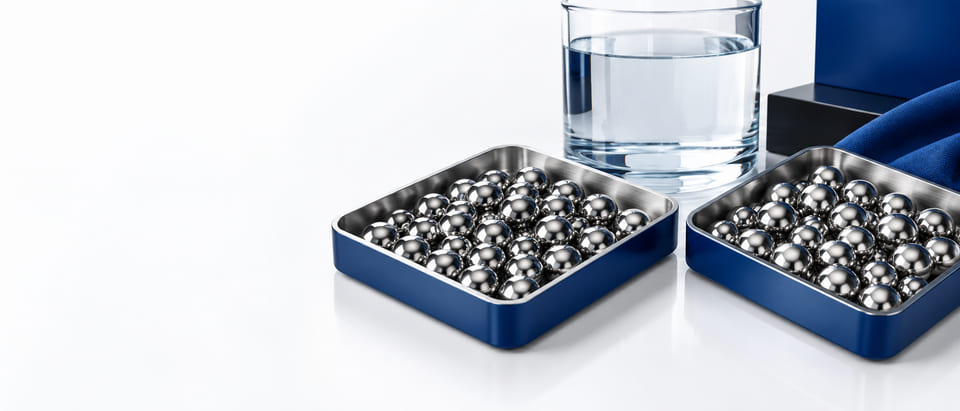
Compare 304 and 316 stainless balls using actual fluid chemistry, temperature, surface condition and validation rather than broad corrosion-resistance claims.
Quick Answer: When Should You Choose 316 Instead of 304 Stainless Steel Balls?
Consider 316 when the actual exposure makes its alloy chemistry relevant, but do not treat it as a universal corrosion solution. Compared with 304, 316 contains molybdenum as a deliberate alloying addition. That difference can be useful in some corrosive conditions, while chloride concentration, temperature, deposits, crevices, cleaning and surface condition still determine the component's risk.
The choice is not settled by the words food, marine or chemical. A ball can experience a more severe local environment where it contacts a seat or traps residue than a general description of the surrounding equipment suggests. Define the liquid, concentration, temperature range, operating cycle and cleaning exposure before comparing materials.
MEITUO's 316/316L ball enquiry route helps connect that information with the required finished geometry and acceptance. State whether the drawing requires 304, 316, a low-carbon variant or an approved alternative. The comparison below is a selection framework; it does not assert that either grade is automatically suitable for a regulated contact or a particular chloride service.
What Does the Alloy Difference Change in a Ball Selection?
Material designations identify a chemistry and specification basis, not a complete finished-component guarantee. The molybdenum distinction between 304 and 316 is useful for screening corrosion candidates, but actual performance also depends on the environment and the condition of the supplied surface.
Keep low-carbon variants separate when the specification calls for them. The letter L does not establish a universal increase in resistance to every chemical exposure. Its relevance must be connected to the material specification, processing history and intended service. Do not automatically substitute a low-carbon designation for another alloy requirement without checking the order.
For a small ball, buyers sometimes assume that every material-identification method can verify every element. Ask whether the selected method can determine the distinction you need. An alloy screening result and a complete material certificate answer different questions, particularly where carbon content or traceability is important.
The finished ball still needs geometry and surface acceptance. A correct alloy can have unacceptable dents, contamination or size variation. Conversely, excellent geometry cannot compensate for an inappropriate material. Keep chemistry, material condition, dimensional inspection and functional validation as separate but connected parts of the purchasing record.
Why Are Chlorides, Temperature and Crevices Important?
A chloride-containing environment cannot be described adequately by the word water. Include the actual concentration where known, temperature, evaporation, flow, deposits and periods of stagnation. Cleaning or drying can concentrate residual material at a contact even when the bulk process liquid appears mild.
Review the geometry around the ball. A seat, retainer or other close interface can create a local environment different from the open surface. Do not evaluate only a clean loose sphere immersed briefly in fresh liquid if the installed component traps residue or operates through repeated wet and dry cycles.
Neither 304 nor 316 should be described as permanently rustproof or universally resistant to seawater. If the exposure is uncertain or particularly demanding, investigate other materials or design changes rather than assuming that moving to 316 completes the engineering work. The appropriate decision may involve cleaning, drainage or the mating component as well as alloy.
Record the exposure that the trial actually represents. A screening result in one concentration and temperature does not establish performance in a different process. A useful material comparison identifies its limits so future changes to the fluid or operating cycle trigger an appropriate review.
304 vs 316 Stainless Steel Balls: What Should the Comparison Table Contain?
Compare the requirement driving the choice. Avoid using a single material ranking for every combination of corrosion, hardness, cost and contact duty. The table below is an original purchasing framework rather than a performance-value datasheet.
| Decision | 304 candidate | 316 candidate |
|---|---|---|
| Corrosion review | Evaluate against the actual medium and surface condition | Evaluate whether its chemistry addresses the identified exposure |
| Mechanical contact | Confirm finished condition, load and mating surface | Confirm the same system requirements independently |
| Cleaning | Specify cleaner, concentration, temperature and cycles | Use the same specified cleaning exposure |
| Documents | Exact designation and lot-linked evidence | Exact designation, including L where required |
| Approval | Defined material and functional tests | The same acceptance basis for fair comparison |
If the present problem is mechanical wear or indentation, changing between these austenitic grades may not address the dominant cause. Review hardness condition, geometry and the complete contact rather than treating corrosion-oriented chemistry as an automatic wear solution.
If the present problem is rust staining, investigate contamination and handling as well as alloy selection. A change to 316 can add cost while leaving the same source of free-iron contamination or retained cleaning residue in place. A sound comparison separates those possible causes before approving the new material.
How Do Surface Condition, Cleaning and Packing Affect the Decision?
Ask how the ball reaches the assembly. Forming, finishing, cleaning, handling and packing can all affect the condition the buyer receives. A surface that appears bright in a photograph may still carry residue or contamination relevant to the actual application.
Keep passivation requirements explicit if they are needed. A material designation alone does not describe every surface-treatment or verification step. Define the applicable process and acceptance evidence with the supplier instead of assuming that all stainless balls have received the same preparation.
Review the buyer's own operations as well. Shared tools, carbon-steel particles, wash chemistry and storage conditions can change the observed surface after receiving. Preserve samples before and after critical stages when investigating a staining problem so the origin is not automatically assigned to the delivered alloy.
Protect the approved condition through packing and assembly. State cleanliness, inner packaging, batch labels and handling limits where they matter. An order that specifies only 316 balls may not communicate a need for low-residue presentation or controlled repacking. The final component should be evaluated in the condition in which it will actually operate.
How Can You Build a Useful 304 vs 316 Compatibility Trial?
Use the actual process fluid and cleaning cycle where feasible. Define concentration, temperature, duration, flow or stagnation, contact geometry and specimen preparation. Include an identified baseline and compare candidates under equivalent conditions. Do not interpret an uncontrolled jar test as complete equipment qualification.
As a hypothetical plan, suppose samples are inspected before exposure, after the process cycle and after cleaning. Record mass where the method is appropriate, visible changes, surface observations and the relevant component function. A ball that looks clean but fails a leakage criterion has not passed the assembly requirement.
An illustrative change calculation can help organize results without predicting corrosion. If an approved measurement plan records a sample mass of 10.0000 g before a test and 9.9995 g after standardized cleaning and drying, the measured difference is 0.0005 g. That arithmetic alone does not identify the mechanism or establish a corrosion rate; balance capability, cleaning effects, area and time need evaluation.
Keep photographs and results linked to each sample. Where analysis is needed, preserve the condition rather than aggressively cleaning every affected specimen. Use the trial to decide a defined question, and record what remains untested before allowing the results to support a recurring order.
What Should an OEM Put in a 304 or 316 Ball RFQ?
Identify the exact material requirement, nominal diameter, controlling units, precision or explicit geometry, surface acceptance and quantity. Add the fluid, temperature range, mating material and cleaning conditions. If an alternative is requested, explain which limitation of the current material you want to address.
State the required documents and their scope. Material identity, treatment or cleaning records, dimensional results and intended-contact evidence are different deliverables. Ask for the records that answer the actual purchasing questions, not an undifferentiated bundle of certificates.
Where food, medical or another regulated contact is involved, define the destination market and use conditions. A stainless designation does not by itself establish the suitability of the finished component for every regulated application. Obtain the appropriate evidence for the actual part and intended contact.
Include sample quantities and the acceptance plan before production demand. The component owner should approve the material and function under defined conditions. Confirm packing, destination and substitution rules so the quotation does not silently select a different grade, surface condition or evidence scope from the one your engineering team expects.
Build an exposure worksheet before asking suppliers to recommend an alloy. Give process liquid and cleaning liquid separate rows. Record concentration, temperature, duration, movement or stagnation, and whether evaporation or deposits change the local conditions. Where a value is unknown, label the uncertainty rather than copying a typical concentration from an unrelated process.
A ball-and-seat assembly needs its own review of the local contact. Fluid trapped at an interface may not be renewed like the bulk stream, and a shutdown can create a different exposure from normal operation. This is why a general description such as water treatment or food machinery does not determine whether 304 or 316 is suitable.
Make the inspection endpoint specific. A trial could involve visible changes, surface examination and the defined functional acceptance, but the selected methods must fit the question. Mass change alone may be difficult to interpret if deposits or cleaning alter the measured result. A small total change also does not necessarily describe localized damage at a critical sealing contact.
Decide what happens if the process changes after approval. A new cleaner, increased temperature or longer idle period can invalidate the assumptions behind a successful material comparison. Keep the accepted exposure record with the component specification, and make the responsible team aware that an alloy selection is conditional on those agreed conditions. This is more useful than a blanket statement that a stainless grade is permanently approved for the entire factory.
How Should Buyers Compare Stainless Steel Ball Suppliers in China and Italy?
A supplier shortlist should reflect the component, not a generic country ranking. This article compares China with Italy as two relevant sourcing contexts. Neither geography nor a catalogue entry proves that a particular diameter, material condition or inspection package is available. Compare actual proposals against one controlled requirement.
The two market notes below are procurement starting points. They do not establish preferred-supplier status, stock, minimum quantities or application approval. The examples illustrate supplier research rather than a ranking. Ask the intended seller to confirm what it will supply and which records will accompany the order.
China: connect the material enquiry to acceptance.
MEITUO Balls in Qingdao is a China-based starting point for this requirement. Connect the proposed grade with material identity and the finished surface acceptance. Keep the proposed source, processing responsibility and legal seller explicit. A translated commercial description should not silently replace the material or inspection requirement on your drawing.
For this purchase, describe the actual medium, cleaning cycle and whether 304, 316 or an L variant is required. Send both sample and production quantities, controlling units, destination and required records. If a supplier offers an alternative, identify the changed characteristic and the person authorized to approve it. Preserve that decision with the quotation rather than treating an email photograph as approval.
Italy: compare the same technical deliverable.
RGPBALLS in the Milan area is an identifiable supplier example to investigate. Review the same fluid exposure and contact conditions when comparing alternative offers. Confirm the offered item and current capability directly; the example is not a recommendation of an unreviewed product.
When comparing this route with MEITUO, separate the component specification from logistics. State the same drawing, quantity, inspection expectations and packing basis. Investigate differences in units or local terminology before comparing prices. If a distributor is involved, clarify which organization controls the inspection evidence and how its lot identity is preserved through repacking.
Evaluate the complete landed purchase: accepted parts, inspection effort, rejection handling and delivery presentation. A lower advertised price does not settle a technical difference. Equally, a local address does not remove the need for material and measurement evidence. Record unresolved questions so the supplier comparison remains reviewable when purchasing, engineering and quality teams meet.
How Can MEITUO Balls Support a 304 vs 316 Enquiry?
MEITUO Balls is the ball-focused website of Qingdao Meituo Steel Co., Ltd., Qingdao, China. Use the team to organize a specification-led purchasing conversation rather than infer finished-component performance from a familiar material name.
For a 304 vs 316 comparison, explain the corrosion concern, existing material and real exposure so the enquiry can separate alloy selection from cleaning or contact problems. Explain what the current part must do, what has failed or which substitution is being considered. A drawing is valuable because it distinguishes mandatory limits from preferences. If a drawing is incomplete, identify the unknowns and the engineering owner who can resolve them. The aim is a clear technical brief, not a guessed specification chosen to fill every field.
Begin with the relevant MEITUO product or application route, then use the quotation page or email [email protected]. Include sample demand, production quantities, acceptance evidence and destination. Keep quotation review separate from final application approval. Supply route, availability, records and commercial terms are confirmed for the particular enquiry.
The most productive recommendation is therefore conditional: consider MEITUO when you need to connect the component requirement with a reviewable supply scope. Do not treat this guide as proof of a specific stock item, certification, in-house laboratory arrangement or preapproved application. Ask for the evidence your purchase actually requires.
304 vs 316 Stainless Steel Balls FAQ: What Should Buyers Ask?
Is 316 always suitable for chloride exposure?
No. Concentration, temperature, stagnation, crevices and surface condition still matter. Validate the actual exposure rather than treating the alloy designation as a universal approval.
Does 316L mean better resistance to every chemical?
No. A low-carbon designation has a specific material significance and is not a general ranking for all environments. Review the required specification and processing context.
Can a magnet distinguish 304 from 316?
Not reliably. Magnetic response depends on structure and processing as well as composition. Use suitable material-identification evidence for the distinction required.
Will an alloy change remove rust caused by contamination?
Not necessarily. Investigate contamination, cleaning and handling. A new alloy can encounter the same external source of staining if the process is unchanged.
Does stainless grade establish food-contact approval?
No. The finished component, intended use, destination requirements and supporting evidence need review. Material identity is only part of that decision.
How should the two candidates be tested?
Use equivalent preparation, actual fluid and cleaning conditions, identified samples and predefined functional acceptance. Record both observations and the limitations of the trial.