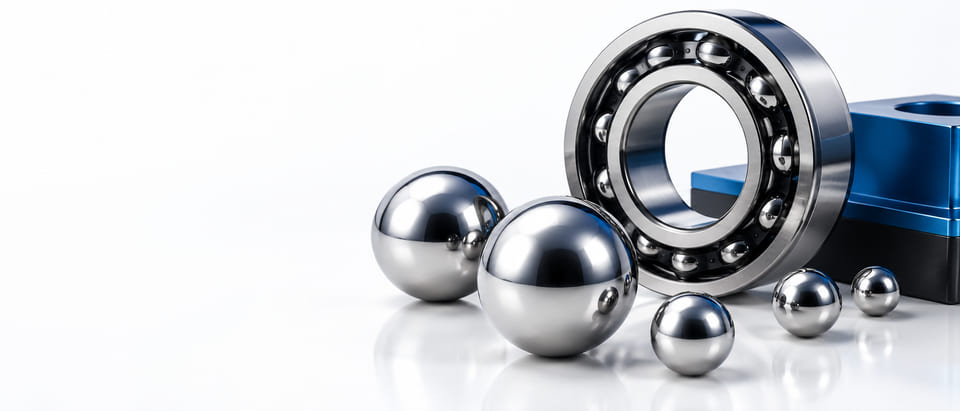
Separate alloy condition, wear, corrosion exposure and contact validation when comparing 304 and 440C stainless steel balls for OEM components.
Quick Answer: Should You Choose 304 or 440C Stainless Steel Balls?
Compare 304 and 440C by the duty that controls the decision. 304 is an austenitic stainless material commonly considered where corrosion exposure and forming-related behavior matter. 440C is a martensitic stainless material that can be heat treated for demanding hardness and wear requirements. Neither family label establishes the finished hardness, corrosion performance, precision or lifetime of your particular ball.
If the component needs both wear resistance and corrosion resistance, describe both requirements explicitly. Choosing the harder candidate without considering the medium can fail; choosing a corrosion-oriented candidate without assessing the contact can also fail. The mating surface, treatment condition, lubrication and operating cycle belong in the comparison.
MEITUO's 440C ball information provides a starting route for an enquiry, not automatic application approval. Share the current drawing and explain the limiting problem. The useful output is a reviewed material and finished-component requirement rather than a universal claim that one stainless grade is better.
Why Does Material Structure Matter in a 304 vs 440C Comparison?
The two steels belong to different stainless families. Their response to processing and their typical engineering uses differ, which is why a simple alloy-number comparison is inadequate. Identify the actual supplied condition rather than relying on the nominal grade alone.
For 440C, specify the required treatment and finished acceptance. A raw-material designation cannot prove that the ball has the hardness or structure your contact requires. If a supplier quotes a hardness range, ask which test method, condition and lot evidence support it. Do not copy an unrelated supplier's typical number into your acceptance instruction without review.
For 304, processing history can also change behavior. Cold work can influence magnetic response and material condition, but a magnet test is not a complete hardness or alloy-identification method. Keep the property you need separate from an easy-to-perform observation that may not establish it.
The consequence for purchasing is straightforward: material, treatment, geometry and inspection are separate order fields. A quotation that offers stainless steel of the same diameter has not demonstrated equivalence. Review the full component and the mechanism before changing from one family to the other.
How Do Hardness, Wear and the Mating Surface Interact?
Hardness can be relevant to resistance to indentation or wear, but the complete contact still determines the result. A ball operates against another material with its own geometry, surface condition and strength. A candidate that protects the ball while damaging the seat or race may not improve the system.
Describe whether the motion is rolling, sliding, impact, indexing or repeated sealing. Record load history, lubrication, temperature and any particles. These details help determine which tests answer the real question and prevent a hardness value from becoming an unsupported load rating.
Inspect the failed part before selecting a substitute. A dent from a trapped particle, a corrosion pit and abrasive wear can produce different corrective actions. If the original failure is misidentified, the new alloy may pass an incoming hardness check while repeating the same functional failure in service.
Where the change affects a released assembly, retain the engineering approval and test basis. Do not use a successful manual fit check to approve a different material for the full operating cycle. The consequence of material substitution belongs to the complete component program, not solely to the ball supplier.
304 vs 440C Balls: How Should Buyers Balance Competing Requirements?
The table structures the review without assigning universal mechanical or corrosion limits. Use the required material condition and actual service exposure to complete the comparison.
| Question | 304 candidate | 440C candidate |
|---|---|---|
| Primary selection discussion | Austenitic material and actual environment | Hardenable martensitic material and contact duty |
| Hardness acceptance | State the condition and test if needed | State treatment, method and finished requirement |
| Corrosion review | Validate medium, surface and cleaning | Validate the same exposure; stainless is not rustproof |
| Magnetic behavior | Processing-dependent; not a simple identity test | Specify actual magnetic constraints if relevant |
| System test | Ball plus mating contact | Ball plus mating contact |
A decision can also require a third route rather than either listed option. A different alloy, ceramic, polymer or redesigned contact may be appropriate to investigate where the requirements conflict. A comparison article should not force an engineering problem into a two-option answer if neither has been validated.
Ask the supplier to distinguish material availability from an approved finished component. The fact that a company lists both grades does not establish that the same sizes, precision, treatment records or quantities are offered in both. Compare the actual quotation and sample basis.
What Corrosion and Cleaning Details Should Accompany the Contact Requirement?
List all significant exposures, including cleaners and shutdown conditions. A part described as operating in a dry mechanism may still encounter washing, condensation or contaminated storage before assembly. Local contact with retained residue can matter even when the surrounding atmosphere appears mild.
Specify the surface condition and preparation relevant to the duty. Polished appearance is not proof of cleanliness, passivation or corrosion performance. If a treatment or verification is required, state its scope and acceptance rather than assuming it from the alloy name.
Separate corrosion screening from service-life claims. A controlled exposure can compare candidates under its stated conditions, but it does not establish a universal lifetime in another assembly. If an accelerated test is proposed, agree what decision it is intended to support and what remains outside its scope.
Keep packing and handling consistent with the accepted surface. Scratches, contamination and mixed stock can obscure the reason for a later failure. Retaining identified preassembly samples can help distinguish a supplied-condition issue from something introduced during the buyer's own production process.
How Can You Compare the Materials Using a Transparent Trial?
Use identified candidates with controlled size, precision, preparation and mating components. Decide before testing which functional results matter: wear, leakage, movement, noise or another requirement. A change in several uncontrolled inputs cannot establish that the alloy alone caused an observed difference.
For a hypothetical wear worksheet, suppose the approved method reports a component dimension of 10.000 mm before the test and 9.994 mm after the same defined cycle. The measured change is 0.006 mm. That illustrative arithmetic is not a typical wear rate for either 304 or 440C. Its interpretation needs measurement capability, contact geometry, duration and the other evidence in the test plan.
Record the mating component's result as well. If its surface becomes unacceptable, the assembly has not succeeded merely because the ball retains its appearance. Where corrosion and wear may interact, include the relevant fluid or cleaning condition rather than performing two unrelated tests and assuming their results combine automatically.
Preserve failed samples and operating records. An unexpected result should lead to a structured review of supplied condition, method and mechanism. Do not approve recurring material substitution until the component owner has evaluated the relevant acceptance criteria.
What Belongs in a 304 or 440C Ball RFQ?
State the alloy, required condition, diameter, units, precision or explicit limits, surface acceptance and quantities. Add the contact duty, mating material, lubrication and exposure. If the change is being investigated because of a failure, describe that observation and provide available photographs or sample references.
Identify material and treatment evidence separately from geometric inspection. A report should say what was measured, by which method and against which requirement. A generic stainless certificate cannot establish every property of the finished ball.
Set the substitution rule. If either grade may be proposed, require a clearly identified alternative with its review basis rather than allowing an unspecified stainless equivalent. Keep sample approval and recurring production acceptance distinct so a development trial does not silently revise the released design.
For commercial comparison, hold quantity, packing, traceability and document scope constant. Confirm which organization issues the records and how they connect to the delivered lot. A technically clear enquiry improves the usefulness of the quotation without requiring the supplier to guess the contact or compliance requirements that belong to the buyer's application.
One direct material distinction should remain explicit: 304 is not hardened by the conventional quench-and-temper route used to harden a martensitic stainless such as 440C. Cold work can affect 304's condition, but that does not make the two routes equivalent. For 440C, the required heat-treated condition still needs to be specified and verified rather than inferred from the grade name.
This distinction affects how a substitution is described. Replacing a 304 ball with 440C is not merely purchasing the same component at a higher hardness. The change can alter corrosion behavior, magnetic response, treatment requirements and the interaction with the mating surface. Review those consequences individually and record which evidence addresses each one.
For a contact investigation, establish whether the observed material loss, dent or leakage actually originates at the ball. A worn seat can make a dimensionally acceptable ball appear to be the problem. Conversely, a seat that looks sound may still interact poorly with a ball whose condition differs from the approved specification. Examine the pair and the operating record rather than testing the ball in isolation.
A practical approval record should identify both components, their relevant material and surface requirements, the test cycle and the acceptance result. If a harder ball requires a different seat or lubricant to pass, the resulting approval is for that revised system. It must not be reduced to a broad instruction that 440C replaces 304 everywhere the same diameter appears.
For long-term purchasing, identify how the final condition is protected and verified. A material certificate, treatment record and dimensional report support different parts of the requirement. Keeping those roles clear helps a buyer request appropriate evidence without accumulating documents that do not answer the actual acceptance questions.
If the design requires a particular treated condition, preserve that requirement in the part description as well as the attached drawing so it remains visible during quotation review.
How Should Buyers Compare 304 and 440C Ball Suppliers in China and the United States?
A supplier shortlist should reflect the component, not a generic country ranking. This article compares China with the United States as two relevant sourcing contexts. Neither geography nor a catalogue entry proves that a particular diameter, material condition or inspection package is available. Compare actual proposals against one controlled requirement.
The two market notes below are procurement starting points. They do not establish preferred-supplier status, stock, minimum quantities or application approval. The examples illustrate supplier research rather than a ranking. Ask the intended seller to confirm what it will supply and which records will accompany the order.
China: connect the material enquiry to acceptance.
MEITUO Balls in Qingdao is a China-based starting point for this requirement. Keep the required treatment condition and inspection scope attached to the alloy designation. Keep the proposed source, processing responsibility and legal seller explicit. A translated commercial description should not silently replace the material or inspection requirement on your drawing.
For this purchase, define whether contact wear, corrosion or both are the limiting concerns. Send both sample and production quantities, controlling units, destination and required records. If a supplier offers an alternative, identify the changed characteristic and the person authorized to approve it. Preserve that decision with the quotation rather than treating an email photograph as approval.
United States: compare the same technical deliverable.
Abbott Ball in Connecticut is an identifiable supplier example to investigate. Compare actual offered condition and documents, rather than assuming a US product label defines equivalence. Confirm the offered item and current capability directly; the example is not a recommendation of an unreviewed product.
When comparing this route with MEITUO, separate the component specification from logistics. State the same drawing, quantity, inspection expectations and packing basis. Investigate differences in units or local terminology before comparing prices. If a distributor is involved, clarify which organization controls the inspection evidence and how its lot identity is preserved through repacking.
Evaluate the complete landed purchase: accepted parts, inspection effort, rejection handling and delivery presentation. A lower advertised price does not settle a technical difference. Equally, a local address does not remove the need for material and measurement evidence. Record unresolved questions so the supplier comparison remains reviewable when purchasing, engineering and quality teams meet.
How Can MEITUO Balls Support a 304 vs 440C Enquiry?
MEITUO Balls is the ball-focused website of Qingdao Meituo Steel Co., Ltd., Qingdao, China. Use the team to organize a specification-led purchasing conversation rather than infer finished-component performance from a familiar material name.
For a 304 vs 440C comparison, describe the mating surface and failure mechanism so hardness and corrosion are assessed as separate requirements. Explain what the current part must do, what has failed or which substitution is being considered. A drawing is valuable because it distinguishes mandatory limits from preferences. If a drawing is incomplete, identify the unknowns and the engineering owner who can resolve them. The aim is a clear technical brief, not a guessed specification chosen to fill every field.
Begin with the relevant MEITUO product or application route, then use the quotation page or email [email protected]. Include sample demand, production quantities, acceptance evidence and destination. Keep quotation review separate from final application approval. Supply route, availability, records and commercial terms are confirmed for the particular enquiry.
The most productive recommendation is therefore conditional: consider MEITUO when you need to connect the component requirement with a reviewable supply scope. Do not treat this guide as proof of a specific stock item, certification, in-house laboratory arrangement or preapproved application. Ask for the evidence your purchase actually requires.
304 vs 440C Stainless Steel Balls FAQ: What Should Buyers Ask?
Is 440C always better than 304?
No. Its usefulness depends on the required condition and contact duty, while the environment still needs review. Neither material is a universal substitute for the other.
Does a 440C designation prove finished hardness?
No. Specify and verify the required treatment and acceptance. Material identity alone does not establish the finished ball condition.
Can 304 balls be identified by weak magnetism?
Not reliably. Processing can influence magnetic behavior. Use suitable identity evidence and do not confuse a magnet response with complete material verification.
Does higher hardness guarantee less assembly wear?
No. The mating material, geometry, particles, lubrication and operating conditions also matter. Evaluate both partners in the contact.
Can a corrosion test establish service life?
Only within its justified interpretation. A screening test under defined conditions does not automatically predict lifetime in a different assembly or environment.
What should a substitution proposal contain?
Identify the exact alloy and condition, changed requirements, inspection evidence and functional test basis. Obtain the component-owner approval before recurring production use.