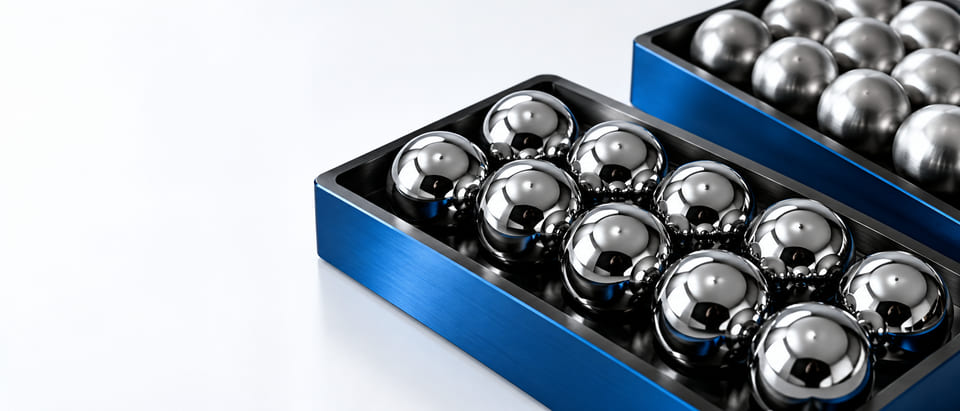
A bearing-material change reaches beyond the loose ball. This guide compares 52100 and specified stainless candidates through the contact system, real exposure and the evidence needed before an OEM approves an alternative.
Quick Answer: Should a Bearing Assembly Use 52100 or Stainless Steel Balls?
Evaluate the bearing system's contact duty and exposure together. 52100 is a bearing-steel material commonly considered for demanding rolling contacts, but it is not a stainless corrosion solution. Stainless steel describes several material families with different treatment and contact behavior. Selecting stainless therefore requires an exact grade and condition, not simply the word stainless on the quotation.
The decision is not only corrosion resistance versus purchase price. Race materials, lubricant, preload, temperature, contaminants and required service behavior can affect the appropriate choice. A ball substitution can change the system even when nominal size and precision grade match.
Begin a MEITUO bearing-ball enquiry with the assembly requirement and the reason for comparing materials. A corrosion complaint, a cleaning exposure and a rolling-fatigue concern need different evidence. This guide focuses on the complete bearing decision rather than treating a loose ball's alloy designation as proof of a particular load rating or service life.
Which Stainless Steel Is Actually Being Compared With 52100?
Specify the proposed stainless grade before making a comparison. Austenitic options such as 304 or 316 and hardenable martensitic options such as 440C do not represent the same material route. A family-level recommendation can conceal the very mechanical or environmental property the component needs.
Record the finished condition and required evidence. A hardenable grade name is not proof of a particular heat-treatment result. A corrosion-oriented alloy name is not proof of suitability in the actual chloride, cleaning or contact environment. Keep these questions separate so the proposal can be evaluated without assumptions.
For 52100, preserve the material specification and any permitted alternatives. Commercial references to related bearing steels may help discussion but do not authorize every designation to be substituted without review. Chemistry, condition and finished acceptance need their controlling basis.
The comparison sheet should show the actual offered material and condition for each candidate. If a supplier cannot identify them, a performance comparison based on a generic product description is premature. Ask the missing question before ordering a trial that may not represent the component you intended to evaluate.
Three material routes make the comparison more concrete. The first is a specified 52100 bearing-steel condition intended for the reviewed contact. Its chromium content should not be confused with stainless status or with an applied chrome coating. Exposure and protection therefore need their own assessment rather than being assumed from the word chrome.
The second route is an exact hardenable stainless candidate such as 440C. Its material family makes heat-treatment hardening a relevant part of the proposal, but the grade name does not establish the final result. State the finished condition, relevant evidence and the bearing-system approval it must support.
The third route is a specified austenitic stainless such as 304 or 316. These are not hardened by the conventional quench-and-temper route used for martensitic stainless. Cold work can affect their condition, but that is not a reason to treat them as equivalent to a hardened rolling-element route. If such a candidate is proposed, engineering must review whether its actual properties and the whole contact suit the duty.
These are qualitative screening distinctions, not generic load ratings. A material that addresses a wet or chemical environment may still require changes to the bearing design or operating conditions. The appropriate outcome can also be to investigate a different component or protection concept rather than force the decision into two nominal alloy choices.
What Makes This a Bearing-System Decision Rather Than a Ball-Only Choice?
Rolling contact brings the ball into a repeated relationship with the races and the rest of the bearing. Geometry, material condition, lubricant, clearance or preload, speed and load history can all influence behavior. A more corrosion-resistant loose sphere does not by itself establish that the complete bearing will satisfy the duty.
Identify whether the buyer controls the entire bearing design or is trying to replace loose balls in an existing assembly. In the latter case, obtain the original requirement when possible. A worn sample cannot reveal every original material, treatment or internal design decision.
Inspect the mating races and assembly condition before assigning a failure to the ball alloy. Corrosion debris, poor lubrication, contamination or damage elsewhere can continue to cause problems after a material change. Record the failure location and operating history so the material trial addresses a defined hypothesis.
If a design authority or original equipment requirement controls the assembly, obtain the appropriate approval for substitution. Matching diameter and a familiar precision label should not bypass that process. The correct purchasing question is whether the revised system is acceptable under its duty, not whether the new loose ball looks superior.
52100 vs Stainless Bearing Balls: What Should the Decision Matrix Compare?
Use this matrix to define the review. It does not assign a universal ranking to every stainless material or establish a load or speed limit for either route.
| Requirement | 52100 candidate | Specified stainless candidate |
|---|---|---|
| Rolling contact | Verify material condition and bearing-system acceptance | Verify its own finished condition and bearing-system acceptance |
| Moisture or chemicals | Review protection and actual exposure | Review exact grade and actual exposure |
| Cleaning | Preserve or restore the required condition | Check cleaner, deposits and surface effects |
| Documents | Material, geometry and relevant treatment evidence | Equivalent evidence for the exact proposed grade |
| Approval | Original or revised assembly validation | Revised assembly validation where a change occurs |
An apparent advantage may introduce a different constraint. A material change that addresses a wet environment could still require a revised contact or load assessment. A conventional bearing-steel route that satisfies contact duty may still need controlled protection and handling. Treat these as system tradeoffs instead of a contest between alloy names.
Compare actual offers with the same inspection and commercial scope. An inexpensive loose-ball price and an engineered bearing assembly quotation are not comparable deliverables. Define whether the purchase concerns loose components, matched parts or a complete qualified assembly.
How Should Water, Cleaning and Storage Be Included in the Selection?
Map exposures across the component's life, including transport, washing, assembly, shutdown and operation. A bearing that runs in a protected lubricated condition may encounter water or cleaning chemistry before that condition is established. Those stages can be relevant even when the normal operating description is dry.
Identify the lubricant and its compatibility with the process. Removing a protective material for cleanliness can create a different storage or corrosion question. An application that cannot tolerate a certain film needs another approved preparation and protection plan, not an assumption that the ball will remain unaffected indefinitely.
For a stainless candidate, record exact fluid and cleaning conditions rather than relying on a marine or food-industry label. Deposits, local contacts and temperature can change the exposure. If the material change is intended to address corrosion, define the evidence that would demonstrate a useful improvement under those conditions.
Preserve the acceptance after delivery. Repacking, shared handling tools and open storage can introduce damage or contamination independent of the alloy choice. A successful sample program should therefore include the relevant receiving and assembly condition, not only a material coupon exposed in isolation.
Map when the protective or lubricated condition exists. An assembled bearing running with its approved lubricant is a different state from loose balls waiting after a water-based wash. If the balls spend time in that intermediate state, the original running-condition material rationale may not answer the storage and handling exposure.
Likewise, cleaning introduced during maintenance can change the mechanism's exposure without any modification to the ball drawing. Record the real sequence and the material contact in each stage. A corrosion observation after cleaning should not automatically be interpreted as evidence that the bearing alloy was unsuitable during its original protected operation.
The practical purchasing output is a named candidate with a defined final and intermediate condition. State what the supplier preserves through delivery and what the buyer establishes before assembly. This allows the material comparison to address the complete relevant route without claiming that a different alloy alone replaces the approved lubrication or qualification plan.
How Can a Controlled Trial Separate Material Effects From Other Changes?
Hold ball size, relevant precision, mating components, assembly procedure and operating conditions constant where the purpose is to compare material. If another input must change, identify it and avoid attributing every result to the alloy alone.
An illustrative test-cost worksheet might assume 12 trial assemblies for one candidate and 12 for another, each requiring 25 minutes of a specified bench procedure. The planned procedure time is 24 × 25 = 600 minutes, or 10 hours. Those numbers describe a hypothetical trial resource estimate; they do not prescribe sample size, test duration or bearing life.
Define the acceptance and test coverage before testing. Short-term movement, noise or temperature observations may answer development questions without proving service life. Where fatigue, safety or long-term reliability is required, use an appropriate engineering qualification rather than extrapolating from a convenient demonstration.
Keep results by assembly and lot, including failed or unusual runs. Inspect both ball and race after the relevant test. A material proposal becomes more credible when the trial can be reproduced and its limits are clear, not when a favorable summary hides conditions or excludes inconvenient observations.
Interpret trial differences at the system level. If a stainless candidate changes the observed temperature or movement, identify whether the assembly conditions were truly comparable before assigning the difference to corrosion resistance or alloy quality. A different lubricant state or preload can create another explanation.
Preserve the original material baseline until the review is complete. A proposed wet-service benefit and an observed contact tradeoff may require another candidate or a revised assembly rather than a simple yes/no decision between the two initially quoted balls. This keeps the material comparison useful without inventing a generic fatigue-life advantage for a particular alloy.
What Must a Bearing-Ball Material RFQ Preserve?
Provide the bearing or component drawing, material and condition, diameter, units, precision requirements, surface acceptance and quantity. Explain load, motion, lubrication, exposure and the reason for comparing 52100 with a specific stainless candidate. An existing bearing reference is useful when the original specification is available.
State whether the enquiry seeks a drawing-compliant repeat item or an engineering alternative. Identify the organization responsible for approving the revised assembly and the evidence required before production. A sample order should not silently become permission to change a released bearing design.
Request the relevant material, treatment and geometric records separately. They establish different aspects of the component. A generic quality certificate is not a measurement report for the delivered balls or a qualification of the bearing under its actual duty.
Clarify lot identification, protection and packaging through delivery and assembly. If a supplier proposes a different finish, lubricant presentation or material designation, require it to appear as an explicit difference. A comparable quotation helps engineering and purchasing evaluate the same defined component rather than independently filling gaps in the request.
How Should Bearing-Ball Buyers Compare China and US Suppliers?
A bearing-ball material comparison benefits from a shortlist tied to the actual assembly. China and the United States are relevant sourcing contexts here, but supplier location does not establish a bearing's suitability or the evidence available for a particular material.
Use one controlled requirement for all proposals. If the component is a replacement in existing equipment, identify the approval basis before discussing a looser material substitution.
China: a specification-led sourcing review
MEITUO Balls in Qingdao can be approached with a 52100 requirement or an explicitly defined stainless alternative. Provide the bearing context, existing material, lubricant and exposure, especially when the enquiry follows corrosion or wear in service.
For a China-based quotation, retain the exact material and treatment requirements when local commercial references are used. Ask for the proposed supply and inspection scope relevant to supplier qualification, and connect the sample with the intended production identity.
United States: compare the actual requirement
Abbott Ball in Connecticut is a publicly identifiable US supplier example for precision-ball research. Confirm its actual proposed material, condition and item scope directly; a broad product description is not a rating for your bearing assembly.
Compare inch or metric drawing control, inspection records and handling condition with the MEITUO proposal. Separate the ball purchase from any complete-bearing engineering responsibility. If the US route includes a distributor, ask how the component's identity and records are preserved rather than assuming a local shipment eliminates traceability questions.
How Can MEITUO Support a Bearing-Material Enquiry?
MEITUO Balls is the ball-focused website of Qingdao Meituo Steel Co., Ltd., Qingdao, China. For a bearing-material question, the useful brief describes the mechanism and proposed change instead of asking for the strongest or most corrosion-resistant ball in isolation.
Bring the current material and drawing, the failed or limiting condition, and the information available about the mating races and lubrication. If a stainless alternative is still open, identify the required property rather than choosing a grade solely from a catalogue. The review can then separate material screening, incoming inspection and assembly qualification.
Start with the bearing application guide and the steel ball category. Add sample and production quantities and explain who owns the material approval.
Consider MEITUO as a China-based enquiry option for organizing those requirements. Actual grade availability, treatment, sourcing, inspection and terms need confirmation for the proposed item. A product page is not proof of a bearing load rating, fatigue life, certification or an already approved replacement for the equipment.
52100 vs Stainless Steel Balls for Bearing Assemblies FAQ: What Should Buyers Ask?
Is stainless steel one material option?
No. Identify the exact grade and finished condition. Different stainless families can create different contact and environmental tradeoffs.
Can matching size and grade prove interchangeability?
No. Material condition, races, lubricant, loading and exposure still need review. The complete assembly requires the appropriate approval.
Will stainless automatically solve a bearing corrosion problem?
No. Review the actual medium, deposits, cleaning, handling and failed surfaces. The cause may involve more than the ball alloy.
Can a short trial establish bearing life?
Not by itself. Define the development question and use an appropriate qualification for any fatigue, reliability or safety requirement.
Are the trial quantities and times recommended test conditions?
No. They are hypothetical inputs for a resource calculation, not a qualification method or a prediction of material performance.
What should a MEITUO bearing enquiry include?
Provide the drawing, exact material or candidate, diameter, precision, quantity, races or bearing context, lubricant, exposure and approval needs.