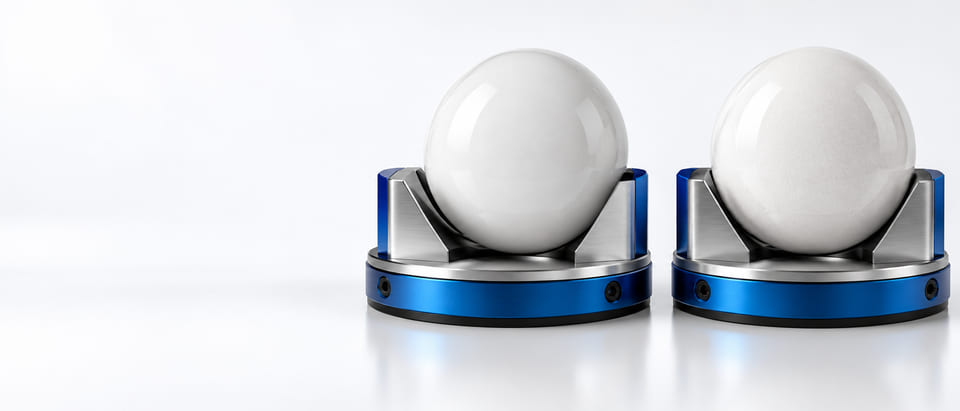
Alumina and zirconia are both industrial ceramic families, but they should not be reduced to white interchangeable spheres. Their grade chemistry, density and fracture behavior create different choices for wear-prone valves, guides and other components.
Quick Answer: Should a Wear-Prone Ball Be Alumina or Zirconia?
Consider alumina when its demonstrated wear, chemical and dimensional performance meets the contact at an acceptable cost. Consider an identified zirconia when toughness or another grade-specific property addresses a defined limitation. Zirconia is generally denser, and transformation-toughened formulations create different mechanical behavior, but neither family is universally superior.
Specify alumina purity and composition, or zirconia stabilizer and grade, rather than ceramic alone. Compare ball and mating-part damage under the real load, motion, temperature and medium. Hardness, flexural strength and fracture toughness describe different properties and should not be substituted for one another.
Use MEITUO’s material-selection route to connect the proposed ceramic with the observed failure. A finished-ball proposal also needs geometry, surface and supply scope confirmed. The correct decision is an accepted contact system and identifiable grade, not a broad claim that the hardest or purest white ceramic must be best.
What Exact Alumina and Zirconia Grades Should Be Compared?
Alumina formulations vary in aluminum-oxide content, additives, microstructure and processing. Higher purity can be useful where chemistry or certain wear requirements justify it, but a purity percentage alone does not establish the best finished component or the lowest accepted cost. The offered grade and relevant evidence matter.
Zirconia includes different stabilized and partially stabilized systems. Stabilizer chemistry, phase structure and processing influence toughness, strength and environmental behavior. A yttria-stabilized proposal is not automatically equivalent to a magnesia-stabilized one, and the generic abbreviation ZrO₂ does not preserve those distinctions.
Transformation toughening in certain zirconias is a specific material mechanism. It should not be described as the ball becoming generally harder whenever it is struck or as permission for uncontrolled impact. Ceramic damage still depends on flaws, contact geometry, stress and environment. A toughness advantage in one grade does not make every zirconia sphere immune to chipping or fracture.
Keep composite ceramics distinct too. Zirconia-toughened alumina is neither a synonym for pure alumina nor simply the same as a zirconia ball. If a composite enters the shortlist, identify it as a separate candidate. A useful material sheet records the exact designation, composition basis, processing state and which properties are typical guidance versus purchased component requirements.
How Do Hardness, Toughness and Counterface Wear Differ?
Hardness concerns resistance to localized indentation under a particular method. Fracture toughness concerns resistance to crack propagation under the relevant framework. Strength concerns failure under a defined stress arrangement and is influenced by flaws and specimen conditions. These are related engineering inputs, but not interchangeable rankings.
A hard sphere can resist its own surface wear while damaging a softer mating part. A tougher proposal may tolerate a particular impact or contact condition differently without giving the lowest sliding wear. The application needs an explicit mechanism: abrasion, adhesive or transfer behavior, particle indentation, edge loading, impact or fatigue.
Inspect the contact pair. Record seat or guide material, finish, alignment and any hard particles. A ceramic ball seated on a sharp edge presents a different risk from a well-supported smooth contact. Foreign particles can generate local stress concentrations and alter both wear and leakage.
If a supplier provides comparative property values, check method, temperature and specimen basis. A flexural-bar result does not directly rate the load capacity of a ball in a custom valve. A hardness value measured on a suitable flat specimen does not establish surface integrity of every finished sphere. Use the data to justify a candidate and a test plan, then evaluate the component and complete contact where function depends on them.
Alumina vs Zirconia: What Should the Selection Matrix Contain?
Use mandatory requirements as gates before commercial ranking. A candidate that fails the required leakage, movement or contamination endpoint should not be rescued by a lower price or attractive hardness value. If both families remain acceptable, compare total cost and supply practicality on the same finished-component basis.
The matrix should include exact grade identity and finished geometry. Small differences in size, shape or surface can influence contact and mask a material effect. If the proposed zirconia and alumina parts are finished by different routes or to different tolerances, document that distinction rather than treating the trial as a pure composition experiment.
Add the mating part and its acceptance criteria. A reduction in ceramic wear is not an improvement if the seat now fails earlier. Product cleanliness also needs its own requirement: ceramic debris, leached constituents and upstream contamination are different questions requiring appropriate evidence.
Separate an initial screening preference from an approved substitution. A candidate may deserve testing because its toughness or density is promising, but that rationale should not be copied into the purchase system as final equivalence before the required contact evidence exists.
Do not assume every ceramic is electrically equivalent. If insulation or another electrical property matters, identify the exact material and test conditions. Resistivity and dielectric strength are different properties, and a room-temperature result may not represent hot or wet service. The mechanical shortlist should not silently decide the electrical requirement.
| Selection factor | Alumina candidate | Zirconia candidate | Decision evidence |
|---|---|---|---|
| Identity | Purity, additives and grade | Stabilizer, phase system and grade | Confirmed offered material |
| Contact damage | Check wear and brittle defects | Check toughness-related benefit and wear | Complete pair under representative duty |
| Mass-sensitive motion | Use exact density | Account for generally higher density | Movement and return behavior |
| Exposure | Check chemistry and thermal sequence | Include grade-specific environmental stability | Conditioned function and inspection |
How Can Density Distort a Ceramic Ball Price Comparison?
Quotations per kilogram can be misleading when materials have different densities and the buyer needs finished pieces. Normalize to the required count, diameter, geometry, acceptance and documentation. Material mass is not the whole finished price, but it is a useful first check on the commercial basis.
For an illustrative 8.00 mm solid sphere, volume is π×0.8³/6 = approximately 0.26808 cm³. Assume densities of 3.90 g/cm³ and 6.00 g/cm³ for two hypothetical alumina and zirconia proposals. Their calculated masses are approximately 1.0455 g and 1.6085 g per ball. These are planning assumptions, not MEITUO product values.
A 20,000-piece requirement would then contain approximately 20.91 kg and 32.17 kg of ceramic respectively, before packaging or other allowances. The denser proposal uses about 1.54 times the material mass at the same count and diameter. Equal prices per kilogram would therefore not mean equal prices per finished ball, and different finishing costs can widen or narrow the actual difference.
Density also changes an equal-speed impact comparison. With the hypothetical masses above, kinetic energy at the same velocity is proportional to mass, so the zirconia proposal would carry about 1.54 times the energy. That ratio does not predict damage: actual velocity, support, contact geometry and material behavior still govern the event. It simply prevents an engineering team from assuming that two equal-diameter balls create the same impact because both are ceramic.
Request a quotation on the same accepted piece quantity and technical scope. Include sampling, inspection, packaging and any qualification costs when relevant. Do not choose solely from theoretical mass: density can also affect ball movement and impact energy in the mechanism, so the engineering review and commercial normalization should remain connected.
Which Chemical and Thermal Exposures Need Separate Review?
Write the actual process and cleaning recipes, concentrations, temperatures and durations. A general corrosion-resistant ceramic description does not establish compatibility with every mixture. Additives and secondary phases can matter, and a polished external appearance does not prove absence of relevant chemical change.
Distinguish thermal shock from long exposure at temperature. A sudden temperature difference can create stresses that a uniform-temperature material limit does not describe. Geometry, heating rate, constraints and contact with other materials influence the result. A published maximum-use temperature is not automatically a valve or bearing rating.
For susceptible zirconia systems, hydrothermal aging is another distinct question. Environmental phase changes can affect certain stabilized zirconias under particular conditions. This should be reviewed for the exact grade and exposure; it is neither a universal failure prediction for all zirconia nor the same mechanism as a single thermal-shock event. Do not import a medical or laboratory aging result directly into an unrelated industrial life claim.
Use retained controls and a defined measurement state when exposure tests are needed. Check the endpoint relevant to the contact: dimensions, surface, strength-related evidence where justified and function. A finite soak without visible damage does not establish an unlimited service life or confirm that the full assembly will retain its required movement or sealing.
What Qualification Plan Produces a Defensible Ceramic Decision?
Start with identified finished specimens and document their initial dimensions and surface condition. Include the actual mating part or a justified representative contact. Define load, motion, temperature, medium, test sequence and rejection criteria before seeing the comparative results.
A ceramic-specific diagnostic sheet should distinguish surface removal from fracture-related loss. A smooth wear track can suggest one mechanism, while a localized chip calls for review of contact edge, particles, handling and overload. Preserve the mating part and unused specimens from the identified proposal. A broken sphere with unknown service history cannot by itself establish that a whole material family is unsuitable.
For each finding, record whether it was present before assembly, appeared during a known event or was discovered only at teardown. That chronology helps avoid blaming a material comparison for transport or installation damage. If a new finishing route removes visible features, verify the resulting dimensions and function rather than assuming improved appearance proves improved reliability. The accepted evidence should remain connected to the actual finished condition delivered for recurring use.
Keep impact, sliding wear and static seating as separate mechanisms where they occur. If service combines them, evaluate the relevant order: impact damage may change later wear, while a worn contact can change subsequent impact. A simplified screen can be valuable, but its conclusion should remain tied to the screened mechanism.
Inspect for local chips, crack-like features, pits, flats and counterpart damage using capable methods. Record the location and preserve specimens before uncontrolled rework. Do not assume a smooth reflection proves a defect-free surface or that a single diameter reading captures local damage.
At release, preserve the exact ceramic grade, finished drawing and accepted contact configuration. If the source proposes another stabilizer system, purity or processing route, review the affected mechanism rather than accepting it as the same ceramic. The useful conclusion states which proposal met which conditions and what remains untested. It should not assign every future alumina or zirconia ball the outcome of one development trial.
Which Regional Routes Support Alumina and Zirconia Ball Sourcing?
Finished-ball supply and advanced-ceramic materials support can both contribute to the decision. Use each route for its actual scope and preserve a shared component and test basis. The following locations are starting points for enquiries, not a ranking or a claim of local stock.
China: Qingdao, Shandong
MEITUO Balls can receive a China-based enquiry with the ceramic candidates, ball drawing and wear mechanism. State the required alumina composition or zirconia stabilizer where known, and identify open selection questions. Confirm proposed material, source and sample scope for the actual order. For overseas receiving, align the grade names and candidate codes before comparative testing begins.
Italy: Cinisello Balsamo, Milan
RGPBALLS publishes alumina, zirconia and composite ceramic ball categories from its Cinisello Balsamo headquarters. This provides a finished-ball sourcing route in Italy. Ask which exact grade and size are offered and what component records can be supplied. The separate catalogue categories should be treated as separate material proposals rather than interchangeable white spheres.
United States: Golden, Colorado
CoorsTek is headquartered in Golden and publishes technical information for multiple alumina and zirconia formulations. This is an advanced-ceramic material and component discussion route. A US engineering team can use exact-grade guidance to frame the comparison, then confirm the particular finished-ball scope. Do not assume every listed material property is a purchased sphere specification or an available ball size.
Compare the same grade identity, accepted piece quantity and contact evidence across regions. A broad ceramics portfolio does not establish that the requested precision sphere is available, and a finished-ball catalogue does not replace the application’s environmental and function tests. Confirm the current offer directly.
How Can MEITUO Help Define a Ceramic Ball Comparison?
MEITUO Balls is the ball-focused website of Qingdao Meituo Steel Co., Ltd., in Qingdao, China. Its published company profile describes a specialty-steel background. A specialist ceramic proposal requires the actual grade, source, dimensions and available evidence to be confirmed for the enquiry.
Send the present contact’s damage pattern and counterpart description alongside the drawing. Explain whether the goal is less wear, greater resistance to a defined impact, improved chemical behavior or a sourcing alternative. This allows the comparison to focus on a measurable need instead of automatically choosing the denser or more expensive ceramic.
Use the sampling and validation route to organize identified candidates. The quotation page or [email protected] can carry the technical package and accepted piece quantities. Keep the material and component evidence connected to the final contact-system approval.
Alumina vs Zirconia Balls FAQ: What Should Buyers Ask?
Is zirconia always better than alumina for wear?
No. Exact grade, counterface, load, motion and environment determine the relevant result. Zirconia’s toughness can help a defined mechanism without making it universally superior for every wear contact.
Does higher alumina purity always justify a higher price?
No. Purity can matter for particular chemical or performance requirements, but the finished component must meet the actual duty. Compare the evidence and accepted total cost rather than selecting purity alone.
Are hardness and fracture toughness interchangeable?
No. Hardness, toughness and strength describe different responses and use different methods. None alone establishes the allowable load or life of a custom ball-and-seat assembly.
Why should zirconia stabilizer be specified?
Different stabilized systems and processing can change mechanical and environmental behavior. A generic zirconia description can conceal material differences relevant to the approved contact.
Does a kilogram quote compare equal numbers of balls?
Not when density or diameter differs. Normalize to the same accepted finished-piece quantity and technical scope, including relevant inspection and qualification costs.
Is hydrothermal aging the same as thermal shock?
No. Hydrothermal aging concerns grade-dependent environmental changes over exposure, while thermal shock concerns stresses from temperature differences or rapid change. Review each mechanism where the actual duty makes it relevant.