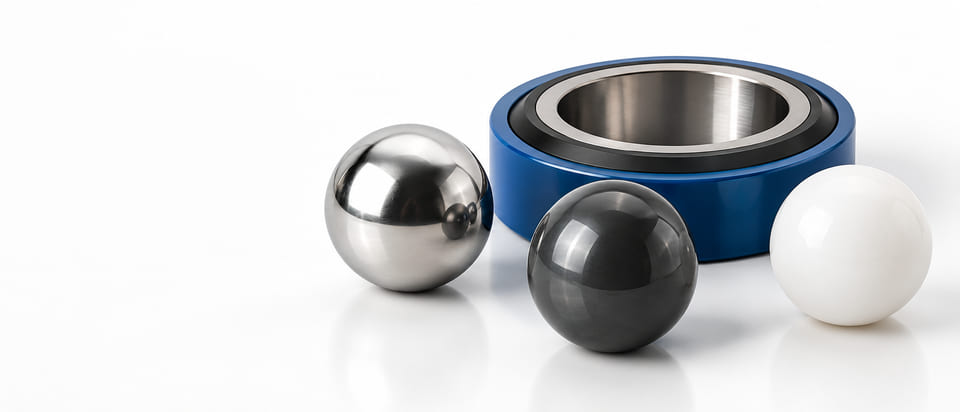
A check ball is part of a moving and sealing system. Selecting it by material reputation alone can overlook the seat, fluid and forces that determine whether the valve actually works.
Quick Answer: How Should Buyers Select a Check Valve Ball Material?
Start with the actual fluid, temperature, cleaning cycle, orientation, seat and closing mechanism. Compare exact material candidates for compatibility, mass, deformation and contact behavior, then validate the assembled valve against defined leakage and movement requirements. A ball that meets its own dimensional specification is not automatically an approved check-valve solution.
MEITUO Balls can use these questions to review a defined component enquiry. Begin with the relevant product or application guide, then identify the conditions that your drawing does not yet resolve.
What Does the Check Ball Need to Do in This Valve?
A check ball must participate in a defined flow-control function, not simply resist the liquid. Identify how it closes, how it opens, how it is guided and what prevents it from escaping or striking an unsuitable surface. The arrangement can rely on gravity, differential pressure, a spring or a combination of forces. Describe the actual construction before selecting a material.
Distinguish a solid check sphere from a bored rotary valve ball. Both may be called valve balls in a commercial enquiry, but their geometries and operating roles are different. A solid sphere for a non-return mechanism should not be quoted as a bored quarter-turn component merely because the requested outside diameter is similar.
Define the required results. Closed leakage, opening behavior, delivered flow, resistance to sticking and durability may all matter. If a failure is already occurring, describe when it appears and preserve the ball, seat and operating history. A replacement material cannot be selected reliably from an isolated photograph without the surrounding mechanism.
The chosen ball must also work with the seat and guide. A soft seat, sharp contact edge, damaged sealing surface or trapped particle can dominate the result. Keep material selection connected to those interfaces. The proper question is which specified ball-and-seat combination can meet the duty, rather than which material has the strongest general reputation.
| Function input | What to describe | Selection consequence |
|---|---|---|
| Closing mechanism | Orientation, pressure and any spring | Required movement and force balance |
| Sealing contact | Seat geometry and material | Pair-level acceptance |
| Operating cycle | Continuous, pulsed or intermittent | Dwell, impact and restart behavior |
Stainless, Polymer, Glass or Ceramic: Which Check Ball Material Fits?
Each material family offers a different combination of mass, deformation, surface response and compatibility. Stainless steel may be considered where metal strength and a specified corrosion response are useful. Polymers can change mass, contact and chemical behavior. Glass and ceramics introduce their own density, surface and damage considerations. None of these families is the universal valve-ball solution.
Specify an exact grade or formulation when the decision requires it. Different stainless alloys cannot be grouped into a single corrosion guarantee. Different polymer grades can respond differently to temperature, chemicals and sustained contact. Ceramic properties also depend on the material and grade; do not assume every ceramic is electrically insulating or equally resistant to impact.
Compare candidates against the same duty. If one option requires a different seat or guide, record that as part of the proposal. The more suitable complete combination may include a design change, but it should not be presented as a direct material swap when other parts have changed.
Use supplier data to establish a shortlist, then define the evidence still needed. A product-family description may help identify plausible materials without proving a particular size, precision, clean condition or leakage requirement. The finished component and assembled valve need their own acceptance basis before commercial approval.
| Candidate family | Useful review direction | Important check |
|---|---|---|
| Stainless steel | Defined strength and alloy requirements | Actual fluid and surface condition |
| Polymer | Changed mass, contact or compatible chemistry | Creep, swelling and dimensional state |
| Glass / ceramic | Specific surface or material properties | Grade, impact and seat pairing |
How Do Ball Density, Fluid Density and Orientation Affect Closing?
Density matters when the mechanism relies on the ball's effective weight or buoyancy. Calculate the volume and displaced-fluid mass using stated units and the actual material proposal. Keep the result separate from dynamic performance, because viscosity, flow, pressure and guiding conditions also influence movement.
As an illustrative calculation, a 10 mm sphere has a volume of approximately 0.5236 cm³. Suppose the ball material density is an assumed 1.4 g/cm³ and the fluid density is an assumed 1.0 g/cm³. The mass difference associated with displacement is approximately 0.2094 g. If the same ball operates in a fluid assumed to be 1.5 g/cm³, the sign changes and the ball tends toward buoyancy rather than sinking under gravity. These assumptions are not specifications for a named polymer or an operating valve.
The calculation explains why a same-diameter substitution can change behavior. It does not establish closing time or a leakage rate. A spring-loaded mechanism or a different installation orientation can change the relevant force balance. Validate the actual construction and describe which forces are intended to produce closure.
Include credible changes in fluid properties where the process requires them. Temperature, concentration, entrained gas or a change of recipe can affect the fluid and mechanism. Do not select a float or check ball from a density value for clean water when the operating liquid is different.
Record ball diameter, material density source, fluid density and temperature, installation orientation, guide geometry, pressure conditions and spring information. If density is critical to release, agree how the finished component or material consistency will be verified rather than relying only on a nominal catalogue value.
How Should Chemical and Cleaning Compatibility Be Reviewed?
Identify the full exposure sequence, including normal fluid, flushing agents, cleaning chemicals, storage and restart. A compatible process liquid does not establish that a material tolerates a hotter or more concentrated cleaner. Mixed residues or long stagnant dwell can create conditions that are absent from a simple operating-fluid description.
For polymers, assess dimensional and mechanical changes as well as visible attack. A ball that grows slightly can stick or change its contact. For metals, surface contamination and the exact alloy condition can matter. For glass or ceramic, specify the material and evaluate relevant chemical and impact questions rather than treating the family name as an unrestricted resistance statement.
Screen with grade-specific information and a controlled test plan where needed. An unloaded immersion study can provide useful evidence about a material response but cannot alone qualify a loaded sealing contact. Carry the selected candidates into representative assembly testing when sealing or motion is the acceptance objective.
Keep regulated-contact documentation distinct from functional compatibility. A material declaration for an intended use does not prove that the valve will seal, and a successful leakage test does not establish compliance for every contact application. Define both evidence needs if both are relevant to the purchase, including the issuing source and the precise component to which the document applies.
Send the exact medium, concentration, temperature, time and cleaning cycle with the enquiry. If a chemical name covers several grades or mixtures, identify the relevant product or composition. An explicit unknown is preferable to a guessed condition that later appears to be an approved design input.
How Should Ball-and-Seat Leakage Be Tested Before Approval?
Define the test medium, pressure differential, direction, temperature, stabilization and observation interval. State the measurement method and units, together with the acceptance criterion selected by the design owner. Two reports marked pass are not comparable if one measures a visible droplet and the other measures a volume under a different pressure.
Test relevant opening and restart behavior as well as closed leakage. A pair that seals well after deliberate seating may behave differently during normal cycling or after a prolonged stop. Include the sequence that explains the actual project question instead of selecting a favorable single test condition.
Inspect both members of the contact. Record the ball and seat identity, their condition before testing, contamination observations and any change after exposure. If a pair is disassembled, document whether reassembly changes the interpretation of later results. Use separate specimens when a measurement or inspection is destructive or materially disturbs the contact.
When comparing materials, control other variables or state the differences clearly. Replacing the seat, lubricant and guide along with the ball may produce a successful complete design, but it does not isolate a material-only effect. The report should establish the accepted configuration rather than suggest that any ball of the selected family will reproduce the result.
A useful validation matrix includes clean initial operation, relevant cycling, defined dwell, cleaning exposure and restart. Select only conditions justified by the duty. Record exceptions, adverse observations and untested limits so a successful trial can support the correct next decision without becoming a blanket performance guarantee.
How Can a Material Decision Be Carried into Repeat Supply?
The approved order description should connect material identity, geometry, surface acceptance and the relevant functional evidence. Keep the ball and any paired seat requirements identifiable. If material alternatives are permitted, state the approval process rather than leaving the supplier to decide that a similar colour or diameter is equivalent.
Define inspection at the right level. Incoming ball checks can establish specified component characteristics; they do not replace valve-level leakage or delivery testing. A chemistry report answers a different question from a dimensional report, and neither alone approves the full machine. Agree which party owns each requirement and which records accompany supply.
Preserve lot identity through packing, receiving and production withdrawals. A mixed container can make it impossible to connect a leakage issue with the relevant material or inspection record. Packaging should protect the surfaces and cleanliness that the contact needs, without implying an unqualified sterile or cleanroom claim.
Review changes to the duty as well as the supplied part. A new cleaner, fluid recipe, temperature or installation orientation can require renewed evaluation even when the reorder number is unchanged. The purchasing record should show what was accepted, which assumptions apply and which changes trigger another technical review.
A focused RFQ identifies the solid check sphere, drawing, units, material requirement or comparison objective, seat and guide, operating sequence, quantity, documentation and destination. Include the reason for replacement if there is one. This makes a MEITUO review more useful than a request for the strongest or most corrosion-resistant ball without context.
Which Suppliers and Local Purchasing Questions Matter for This Project?
The following supplier examples connect component sourcing with practical receiving and qualification questions. They are research starting points rather than a ranking. The proposed product, size, documentation and commercial scope should be confirmed directly for the actual purchase. Keep the same technical acceptance basis when comparing quotations from different locations.
China: Qingdao, Shandong
MEITUO Balls in Qingdao can review a China-based enquiry for solid check spheres, with material and supply scope defined for the actual component. Keep the ball separate from a complete valve in the purchasing description. Include seat geometry, fluid, orientation and acceptance needs so the offered sphere can be assessed against a relevant specification rather than an assumed valve function.
Italy: Cinisello Balsamo, Milan
RGPBALLS publishes multiple ball-material references with fluid-control applications. An Italy-based supplier comparison can use those families as a starting shortlist, but exact material, geometry and current availability still require confirmation. Compare the same ball-and-seat duty and report scope with a Chinese proposal. A published application list does not establish acceptance for the buyer’s pressure, cleaning cycle or leakage criterion.
India: Agra, Uttar Pradesh
Dular Steel Products publicly describes precision balls across several material groups and customer requirements. For an India-focused sourcing review, identify the exact material designation, solid geometry and controlling units. Confirm the offered grade and evidence directly. Keep the purchase of a component distinct from qualification of a complete check valve, and do not infer an approved seat pairing from the supplier’s general material range.
Compare offers using the same duty and acceptance requirements. An office address or familiar material name does not establish local stock, approved application performance or interchangeable supply. Keep the legal seller, source responsibilities and drawing revision identifiable. The choice between a domestic and international route should consider the cost of qualification, communication, inspection and replenishment as well as the first unit price.
How Can MEITUO Balls Support a Specification-Led Enquiry?
MEITUO Balls is the ball-focused website of Qingdao Meituo Steel Co., Ltd., in Qingdao, China. Its published company profile describes a specialty-steel background and a component-focused purchasing conversation. The source, processing, inspection and supply responsibilities are established for the particular component enquiry. Discuss any manufacturing-source or laboratory requirements with the proposed order so the documented scope answers your supplier-qualification questions.
For check-valve material selection, send the specific decision you need to make, not simply a request for the best material. Include the current drawing, operating conditions, expected quantities and the evidence that will allow your team to approve the next step. Identify which requirements are fixed and which alternatives may be proposed. MEITUO can be included in that review without treating a catalogue description as finished-component qualification.
Explore the relevant component guide and sampling and validation route. Confirm technical acceptance and commercial terms in the quotation before committing to an order or changing an approved material.
How to Select a Check Valve Ball Material for a Real Fluid FAQ: What Should Buyers Ask?
Is chemical resistance enough to choose a check ball?
No. The ball must also move and seal with its seat and guide under the actual cycle. Density, deformation, impact, dimensions and cleanliness can matter. Use compatibility information to shortlist materials, then validate the relevant assembly function.
Can a plastic ball replace a steel ball of the same diameter?
Only after review. A change in mass, buoyancy, stiffness and chemical response can affect closure and movement. The mating seat and guide may also need evaluation. A matching outside size does not establish an interchangeable component.
Why does installation orientation belong in the RFQ?
Orientation can change how gravity and other forces contribute to movement and closure. Describe the actual mechanism, pressure and any spring. A material-density calculation does not by itself establish performance in every mounting arrangement.
Does a good ball inspection report prove low valve leakage?
No. It addresses the specified component characteristics. Leakage depends on the pair, contamination, installation and test conditions. Define a separate valve-level acceptance method when sealing performance is required.
Should all materials be compared using the same test?
Use the same relevant acceptance basis, but document any design or preparation differences. If an alternative needs another seat or configuration, evaluate the whole proposal and avoid attributing the result solely to ball material.
What should MEITUO receive for check-valve selection?
Provide the actual fluid and cleaning cycle, temperature, orientation, ball and seat drawings, guide, pressure conditions and quantities. State leakage and movement requirements, known failures and permitted alternatives so the enquiry supports a specific engineering decision.