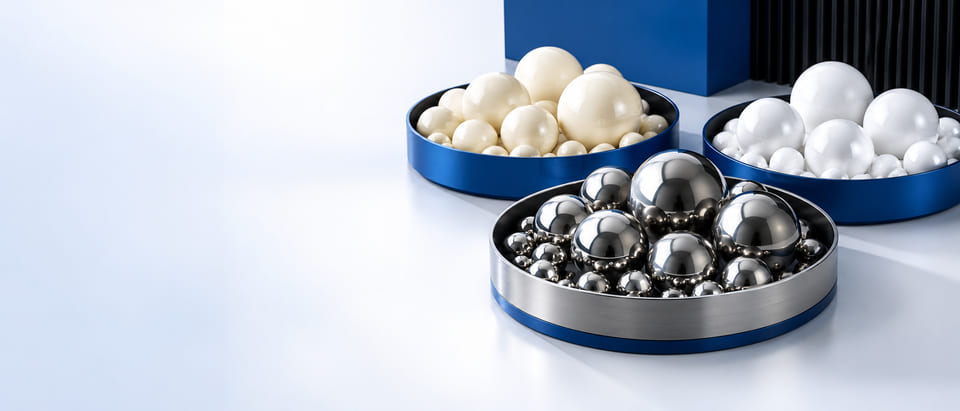
A grinding-media decision is only successful when the processed product and the equipment remain acceptable. Begin with the required output, then compare material, charge and evidence as one defined process proposal.
Quick Answer: How Should Buyers Select Grinding Media Material?
Define the product endpoint, relevant contamination limits, equipment configuration and process conditions. Compare exact media compositions or grades, density and size basis, wear and damage observations, then validate the required product result. The hardest or densest material is not a universal choice, and a catalogue description does not qualify the full process.
Bring the product endpoint, contamination budget and current charge basis to MEITUO’s fine-grinding and dispersion review. Identify whether the comparison is limited by purity, density, wear or equipment contact before selecting another media proposal.
What Product Requirement Should Lead Grinding Media Material Selection?
Start with the product that the process must deliver. Identify the particle-size or dispersion result, permissible contamination, fluid or dry-process conditions, temperature and other relevant acceptance. The hardest or densest sphere is not automatically the best choice when the resulting product must also meet purity or functional requirements.
Separate the limiting problems. A process may need faster size reduction, lower added iron, less breakage, a different flow response or reduced equipment wear. Those objectives are not interchangeable, and an improvement in one can create a cost elsewhere. Record which result is mandatory and which is a preference before comparing material offers.
Clarify the type of operation. Precision rolling balls, surface-finishing media and media for fine grinding or dispersion may all be spherical but have different specifications. The material and acceptance appropriate to a bearing do not automatically define a media charge. Conversely, a process-media size distribution is not a precision-bearing grade.
Use the equipment and product together to establish candidate directions. A material proposal must be compatible with the machine's permitted configuration and the process requirements. Supplier catalogue data can support screening, but the actual trial needs a defined charge, operating basis and product endpoint. The purchasing decision should explain what the media is required to achieve rather than merely naming a material family.
| Product requirement | Media question | Evidence needed |
|---|---|---|
| Purity | Which constituents can be introduced? | Relevant product analysis and source review |
| Grinding result | Does the charge reach the target endpoint? | Defined product and process measurements |
| Reliability | How do media and equipment deteriorate? | Wear, fragments and operating observations |
Steel vs Glass vs Ceramic Grinding Media: Which Trade-Offs Matter?
Compare exact material proposals, not broad rankings. Steel media can introduce a different density and elemental composition from glass or ceramic. Glass and ceramics vary in composition, density, damage behavior and finishing. Even within a named ceramic family, the offered grade and manufacturing basis can matter to the process.
The composition determines which contamination questions to ask. A change away from steel may reduce one potential source of iron without eliminating all material introduced by the media or machine. Another constituent may become important. Do not describe a nonmetallic charge as zero-contamination merely because it is not steel.
Geometry and distribution remain separate from chemistry. Media diameter, shape and size distribution influence the charge and its separation from product. A supplier's nominal size should be connected to an actual agreed distribution or dimensional requirement. A material change combined with another size distribution should be treated as a changed proposal, not a controlled material-only comparison.
Keep damage and recovery in the review. A low measured wear value can conceal breakage, retained fragments or preparation issues if the test boundary is incomplete. Material screening should therefore include the relevant product outcome, surface or fragment observations and equipment response. Buying an apparently premium material does not remove the need to establish how the finished media performs in the specified process.
| Family | Useful screening direction | Review before release |
|---|---|---|
| Steel | Defined composition and process contact | Elemental contamination and equipment pairing |
| Glass | Specified composition and media presentation | Damage, size distribution and actual duty |
| Ceramic | Exact grade, density and wear proposal | Constituents, fragments and product result |
How Should Density Be Connected with Equipment and Operating Conditions?
Density changes the mass of an equal volume of media. That can affect the process, but it does not establish a universal setting or a guaranteed grinding benefit. The equipment geometry, permitted charge, speed, product properties and target endpoint must be considered together. Follow the relevant equipment requirements when evaluating an alternative.
Define whether a proposed charge is being compared by mass, volume or another specified basis. Replacing equal masses of different-density materials can change occupied volume; replacing equal volumes can change mass. If that distinction is hidden, the trial may compare two different operating charges while attributing the outcome entirely to material.
Record the complete setup. Product concentration or viscosity, fluid, temperature and operating sequence may influence the result in wet grinding. Dry processing creates its own handling and contact questions. A nominal machine setting without the product and charge context is not enough to reconstruct a trial.
Compare the accepted product endpoint as well as time or energy. Two media proposals operated for the same duration may not achieve the same result. A shorter cycle or lower apparent power draw is only useful if the output still meets the required distribution or dispersion quality. Preserve actual measurements and their boundary rather than converting supplier material data into an equipment performance promise.
The trial brief should show material and grade, media distribution, charge basis, equipment configuration, product recipe, relevant settings, temperature history and measured output. If a setting changes between candidates, explain why and report the outcome as a comparison of complete process proposals.
How Can a Contamination Budget Guide the Media Shortlist?
Define the relevant constituent and the maximum permitted concentration in the finished product, including its measurement basis. Contamination can originate in feedstock, media, equipment, preparation or handling. Establish a baseline before assigning the whole finished-product result to the media charge.
Consider an explicitly hypothetical budget. A product limit for one named constituent is assumed to be 20 mg/kg. If the measured baseline contribution is assumed to be 8 mg/kg, the remaining arithmetic allowance is 12 mg/kg. Across a 100 kg product quantity, that corresponds to 1,200 mg, or 1.2 g, of that constituent. These numbers illustrate budgeting only; they are not limits or measured results for any material supplied by MEITUO.
Do not equate that allowance directly with permissible total media mass loss. The media composition, distribution of released material, product recovery and other sources need appropriate interpretation. A separate product analysis can answer a different question from the recovered-charge mass account. State the assumptions and analytical method rather than hiding them in a single purity score.
If a material change addresses one constituent, check the new proposal's relevant constituents as well. A successful reduction of one contamination source may not satisfy the complete product specification. The useful shortlist identifies which materials are worth testing and which evidence can disqualify them before production commitment.
Include analytical sample identity, preparation, method, detection or reporting limits where relevant, and the process condition represented. A result below a reporting limit is not the same as a claim of absolute absence. Coordinate the required evidence with the product owner before interpreting a media trial as a purity approval.
State whether a product concentration limit applies to wet product, dry solids or another specified mass basis. Changing that denominator can change the interpretation even when the analytical amount is unchanged. Record moisture or solids information where it is relevant, and keep the same basis when comparing trials. A contamination allowance calculated for one product state should not be silently applied to another after drying, dilution or concentration. This protects the purity comparison from an avoidable accounting error.
Why Must the Mill Contact Surfaces and Separation System Be Reviewed?
Grinding media does not operate in isolation. Contact surfaces, chamber or liner material, grinding tools, seals and the media-separation arrangement can influence wear, contamination and operating reliability. A material suitable in one machine configuration is not automatically appropriate in another.
Review the proposed pairings with the equipment owner or appropriate technical route. A harder media description does not establish that the machine's contact surfaces will remain acceptable. The process can move wear from one component to another, so a favorable media consumption result should be considered alongside equipment observations and product analysis.
Media size distribution also matters to separation. Worn or broken pieces may interact differently with screens or other features than the original charge. Define how the process identifies and handles material no longer within its accepted condition. Do not apply another machine's minimum-size rule or replacement interval without checking the actual configuration.
For trials, retain observations of the equipment and product path rather than inspecting only the balls. Document unusual deposits, fragments, contact damage or changed operating behavior. Where recovery is incomplete, record that limitation in the mass account. A process-level issue should not be assigned to a supplier lot solely because the latest charge is the most visible changed item.
A useful technical handover links media identity with the permitted equipment configuration, the relevant contact materials, separation constraints, product acceptance and inspection plan. The supplier can review the proposed component while equipment operation and complete-process qualification remain explicitly assigned responsibilities.
What Trial and Purchasing Record Supports a Repeatable Media Decision?
Use a staged comparison with identified material proposals and a defined product endpoint. The initial trial can establish feasibility or identify an unfavorable contamination response without claiming to qualify every production condition. Record what the experiment is intended to decide and which questions remain for later work.
Preserve the complete measurement basis. Media consumption, product analysis, particle-size or dispersion result, processing time and equipment observations each answer a different part of the selection question. Keep them separate so the purchasing team can see a trade-off rather than accepting a single unexplained total performance label.
When moving from laboratory to production, review differences in equipment, charge, energy or time basis, product flow and separation. Do not multiply a favorable laboratory result directly into an unlimited production guarantee. Select a suitable scale-up and release approach with the process owner, using the actual proposed conditions.
For recurring supply, identify accepted composition or grade, media dimensions or distribution, relevant quality records, packaging and source. Define changes that need review. A new material source or process can require another look even when the product name is unchanged. Keep the trial and approval references with the purchase so a later quality concern can be investigated against the actual accepted proposal.
Compare total accepted process outcomes and costs: media purchase, consumption, product rejection, equipment attention, verification and interruption where relevant. A low unit price can be a poor choice if it misses the product requirement; a more expensive material can also be unnecessary when it adds no useful result under the defined duty.
Which Supplier Routes Help a Grinding Media Material Review?
A media shortlist can involve a component supplier and an equipment-led technical route. Compare their proposed scope explicitly: a quotation for spheres is not the same deliverable as a process trial. The following examples provide location and sourcing context without ranking countries or promising availability.
China: Qingdao, Shandong
MEITUO Balls can receive a China-based enquiry describing the exact grinding or dispersion function, current media, product endpoint and contamination question. Identify the proposed material and dimensional basis, quantity and required records. Confirm the component source and inspection scope for the actual item. Keep operating settings, equipment compatibility and complete-product acceptance with the responsible process parties rather than inferring them from a media listing.
Germany: Selb
NETZSCH Grinding & Dispersing publishes grinding-media and equipment guidance through its Selb-based business. Its technical route illustrates the importance of matching media, machine and application. Confirm current product and support scope directly for the project. When comparing a German equipment-led proposal with a component enquiry in China, align the product objective and evidence while keeping the responsibilities distinct. A supplier process reference is not an automatic operating instruction for another machine.
Use the same material identity, product endpoint and contamination budget when reviewing offers across markets. Preserve units and the distinction between typical media information, actual trial measurements and accepted production scope. A supplier location is useful commercial context, but it does not establish that a proposed charge has already been qualified for the buyer’s product or equipment.
How Can MEITUO Balls Help with This Purchasing Decision?
MEITUO Balls is the ball-focused website of Qingdao Meituo Steel Co., Ltd., based in Qingdao, China. Its published company profile connects a specialty-steel background with industrial-ball enquiries. The proposed source, processing, inspection and commercial scope are confirmed for the specific component requirement.
For a media-selection enquiry, identify whether the limiting issue is product contamination, grinding result, media consumption or equipment contact. Provide the accepted output requirement and the current charge basis so MEITUO can review a defined component proposal. Keep analytical tests, equipment settings and production qualification explicitly assigned. A useful quotation should preserve the proposed material and evidence scope without being mistaken for a finished process guarantee.
Use the relevant MEITUO guide and quotation route to bring the drawing, quantities and open questions together. Keep the agreed scope with the purchase reference so a later change can be reviewed against the same basis.
Grinding Media Material Selection FAQ: What Should Buyers Ask?
Is the densest grinding media always the best choice?
No. Density interacts with charge basis, equipment, product and operating conditions. Compare the accepted product result and relevant contamination and reliability questions. A material property alone does not prescribe the correct machine setup or establish an improved process.
Do ceramic media eliminate contamination?
No universal claim is justified. Media and equipment can introduce relevant constituents, and a material change may shift which constituent matters. Use a defined product budget and suitable analysis rather than treating a non-steel charge as absolute purity.
Can media mass loss be compared directly with a product concentration limit?
Not without the required material, recovery and distribution interpretation. A charge mass account and an analytical concentration result answer different questions. Keep the named constituent, units, baseline and measurement method explicit.
Should equal masses of different materials be used for every trial?
Not automatically. Equal mass and equal volume can describe different charges when densities differ. Define a suitable comparison basis with the equipment and process owner, record differences and evaluate the required product endpoint.
Does a favorable laboratory trial qualify production scale?
Only within an appropriately established qualification basis. Equipment, charge, flow, energy and separation can change with scale. Use the laboratory result for its stated decision and review the production conditions before extending approval.
What should MEITUO receive for media material selection?
Send the product objective, current and proposed media, machine and contact-material context, contamination requirements, size basis, quantities and relevant trial data. Identify the unresolved trade-off so the enquiry reviews a defined component proposal rather than a universal best-media claim.