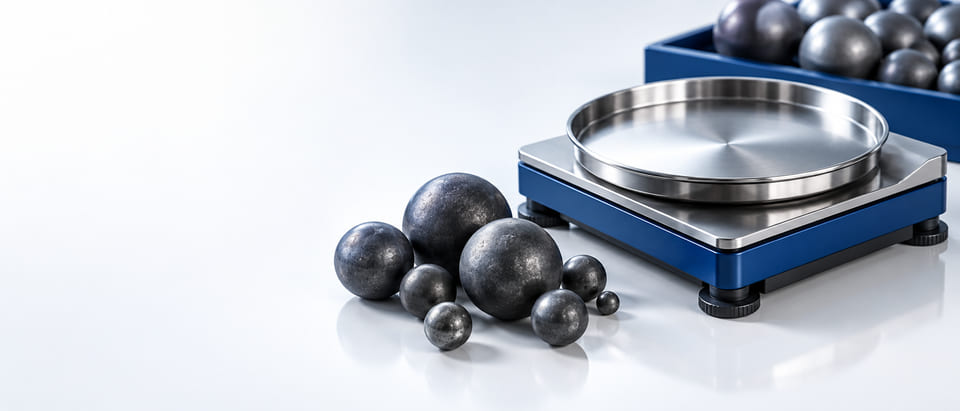
A wear-rate number becomes useful only when its mass boundary, denominator and product result can be reconstructed. The worksheet should explain where the grams went before it decides which media offer is better.
Quick Answer: How Should Grinding Media Wear Rate Be Measured?
Define the media charge, preparation, documented additions and withdrawals, recovered final mass and the selected denominator. Separate the apparent mass difference from proven abrasive wear, breakage or recovery loss. Report units with the result and retain the product endpoint. Use an appropriate analytical test when the purchasing question concerns contamination rather than media consumption.
Bring the media mass account and required product endpoint to the fine-grinding and dispersion enquiry. MEITUO can review the proposed component while equipment and process responsibilities remain defined.
What Does a Grinding Media Wear Rate Actually Measure?
A wear-rate result describes a measured material loss divided by a stated basis. That basis may be time, processed-product mass, energy input or another quantity appropriate to the process. The unit belongs with the number. Comparing two bare values called wear rate can reverse the purchasing conclusion if their denominators differ.
Define the media boundary as carefully as the denominator. A batch of balls can lose material by abrasion, breakage, removal of undersize pieces, sampling or incomplete recovery. A change in recovered mass is not automatically abrasive wear. Deposited product can add mass and mask a loss. Cleaning can remove deposits but may introduce another measurement bias if preparation is inconsistent.
State why the result is needed. A product-purity investigation may focus on the constituents entering the product, while a replenishment plan may focus on media consumption. The same experiment can provide useful information for both, but one measurement does not necessarily establish the other. A low net loss does not guarantee that the product's contamination limit was met.
Record the initial media lot, material, size distribution and process conditions. A test using a fresh narrow distribution should not be compared casually with an operating charge containing worn and newly added pieces. The engineering question is whether the measured result represents the supplied proposal under the duty being evaluated.
| Reported basis | Example unit | Question answered |
|---|---|---|
| Operating time | g/h | Loss during the defined running period |
| Product processed | g/kg product | Consumption relative to output |
| Energy input | g/kWh | Loss relative to recorded energy |
| Product analysis | mg/kg of a constituent | Product contamination under the analytical method |
Gross Mass Loss vs Abrasive Wear: What Must Be Reconciled?
Create a mass-accounting record before assigning a mechanism. Weigh the defined initial charge under an agreed preparation condition. During the test, log additions, withdrawals, samples, breakages and removed undersize media. At the end, recover and prepare the remaining charge using the same stated basis. Preserve the records that explain the difference.
A useful accounting expression is initial media mass plus documented additions, minus documented media withdrawals and recovered final mass. It gives a residual mass difference within the chosen boundary. That difference may include abrasive loss, unrecorded fragments and recovery errors. Call it a reconciliation result until the other contributors have been examined.
Keep product residue visible as a separate concern. A wet or coated final charge can weigh more than the comparable clean charge. Conversely, a harsh preparation method can change the media or remove material not lost during grinding. Agree washing, drying and equilibration procedures suitable for the material and process before relying on small differences.
Record recovery limitations. If material remains in an inaccessible mill region, the final mass is incomplete. A result can still inform the project when its limitation is clear, but should not be promoted as a precise material wear constant. The purpose of reconciliation is to prevent a purchasing decision from assigning every missing gram to the wrong mechanism.
| Mass movement | Treatment in record | Common mistake |
|---|---|---|
| Fresh media addition | Add to the accounted charge | Ignore additions and understate loss |
| Removed sample or oversize piece | Log as documented withdrawal | Count it as abrasive wear |
| Product residue | Control preparation and assess effect | Weigh residue as remaining media |
| Unrecovered fragments | Identify uncertainty in boundary | Treat unexplained loss as a proven mechanism |
How Can Buyers Calculate Comparable Wear Units?
Consider an explicitly hypothetical run. An initially prepared charge weighs 5,000 g. No media is added or intentionally removed, and the recovered final prepared charge weighs 4,988 g. The apparent mass difference is 12 g. If the documented running time is eight hours and the processed-product mass is 40 kg, the corresponding apparent rates are 1.5 g/h and 0.3 g/kg product.
These calculations do not prove that all 12 g entered the product or was lost by abrasion. A fragment trapped in equipment, an unrecovered sample or inconsistent preparation can change the interpretation. Retain the term apparent loss until the mass boundary and other contributions are adequately reconciled.
If a separate analysis finds a target constituent in the product, report its concentration and analytical basis separately. Converting a whole-media mass loss directly into a guaranteed concentration of one element requires assumptions about composition, recovery and product distribution. Those assumptions may not hold. An analytical result also needs its own sampling and measurement interpretation.
Use units consistently. Grams per kilogram and kilograms per tonne are numerically equal, but milligrams per kilogram are a different scale. Do not compare a time-based rate with a throughput-based rate without the corresponding production data. A faster process can show another g/h result while producing a more favorable consumption per kilogram.
Retain initial and final readings, run duration, output mass, units and any conversion factor in separate worksheet fields. Include the balance capability and preparation method. A transparent calculation is more valuable than a polished dashboard number whose denominator cannot be reconstructed.
Which Process Conditions Must Remain Comparable?
Media material is only one variable in a grinding process. Equipment geometry, contact surfaces, filling, operating conditions, product properties, viscosity or dry-flow behavior and the target particle-size result can influence the observation. An experiment should identify which variables were held constant and which were deliberately changed.
Compare at the appropriate product endpoint. Two charges run for the same time may not produce the same particle-size distribution or dispersion result. One may simply have performed less useful processing. A consumption comparison needs the corresponding product outcome, otherwise low loss can be mistaken for a material advantage when the process objective was not achieved.
Distinguish actual measured energy from an assumed nominal value if energy-normalized results are needed. Include the relevant operating period and measurement boundary. Equipment settings or nameplate values do not automatically describe the energy that reached the product and media during a particular run.
Record the media size distribution before and after testing where it matters. Wear can change the operating charge, and removed fragments or undersize pieces can affect equipment behavior. A mean diameter alone may conceal a wide distribution. Use an appropriate measurement or separation method and preserve how the sample was selected so subsequent tests can be interpreted on the same basis.
A useful comparison sheet contains material and grade, charge condition, size distribution, process recipe, equipment configuration, operating sequence, output endpoint, recovery method and the selected normalization. Mark unmeasured variables explicitly. Do not manufacture a like-for-like claim where the two trials were operated under different conditions.
How Should Repeatability and Small Mass Differences Be Evaluated?
Before interpreting a small difference between candidates, understand the measurement and recovery variation. Balance resolution is not the complete uncertainty of a result. Preparation, trapped product, specimen transfer and incomplete recovery may contribute more variation than the display increment suggests. Evaluate the entire method, not only the instrument specification.
Repeated observations can help establish whether a difference is stable enough to support the intended decision. Define which conditions are repeated and retain individual results. An average should not conceal a run with breakage, a recovery problem or a different product endpoint. Report excluded runs with the reason rather than silently removing inconvenient values.
Use controls appropriate to the investigation. A preparation-only or recovery check may reveal a method effect without a full grinding exposure. A known reference charge can help compare successive trials when the process changes over time. These checks do not replace relevant production testing, but can prevent a false explanation of a small laboratory difference.
Select acceptance in relation to the actual consequence. A result may be adequate for planning replenishment but inadequate for a sensitive contamination budget. Agree the required confidence and evidence with the process owner. Do not claim a precise difference in material wear if the test cannot distinguish that difference from recovery or preparation variation.
Photograph and retain unusual fragments where the procedure allows, and record observations of the mill contact surfaces. The investigation may need to separate media-derived contamination from equipment-derived contamination. A consumption number by itself cannot identify every source of material entering the processed product.
How Can a Wear Worksheet Support Purchasing and Replenishment?
Use the result as a documented process observation, not a universal property of a material family. Link the charge identity, trial conditions, measured product outcome and accounting method to the purchasing decision. State whether the evidence supports a material shortlist, a production trial or a recurring supply requirement.
For a replenishment plan, distinguish consumption from the removal of out-of-specification media. Both can require additions but may have different causes and controls. Keep additions, sorting and charge changes traceable so a later apparent increase in consumption can be investigated rather than attributed automatically to the latest supplied lot.
For supplier comparison, request the exact offered material, size and quality basis. Steel, glass and ceramic media should not be treated as interchangeable merely because they are spherical. A different density, composition or size distribution may require another process setup and contamination assessment. Compare accepted outcomes and relevant total cost, not a wear number detached from the trial.
For recurring orders, define the media identity and changes that need review. Preserve batch labels and the accepted specification through delivery and charging. If the equipment, product recipe or purity requirement changes, establish whether the earlier test still represents the duty. This keeps a useful worksheet connected to the process it was designed to support.
The handover should retain the raw mass account, selected units, product endpoint, inspection and preparation methods, limitations, source identity and approval. Include any open question about fragments, recovery or contamination. A clear unresolved issue is preferable to turning a residual mass difference into an unsupported lifetime or purity promise.
Which Supplier Routes Help a Grinding-Media Wear Comparison?
Supplier research should connect the media proposal with the equipment and measurement boundary. The examples below illustrate a component enquiry route and an equipment-led process route; they are not a ranking or proof that every offered material will produce the same wear result.
China: Qingdao, Shandong
MEITUO Balls can receive a China-based enquiry identifying the actual media material, dimensions, process and required evidence. Send the mass-accounting worksheet and product endpoint if comparing a current charge with another proposal. Confirm the proposed source, material identity and inspection scope for the order. A ball quotation should not be interpreted as approval of a mill setting or a guaranteed contamination rate. Keep equipment-specific operating responsibilities with the process owner.
Germany: Selb
NETZSCH Grinding & Dispersing publishes equipment and grinding-media guidance associated with its Selb-based business. Its media-selection material emphasizes the combination of machine, application and operating factors. This is a useful example of an equipment-led technical route when a comparison also changes process conditions. Confirm current support and product scope directly. Compare the same measurement boundary and product result with a component-only sourcing proposal rather than treating an equipment trial and a loose-media quotation as identical offers.
In a cross-border comparison, keep units and preparation procedures explicit in the test brief. A report translated into another language should preserve whether a number is gross loss, reconciled residual, consumption or product analysis. Agree who owns equipment settings, recovery, analytical testing and the purchasing release so no party assumes that another has already approved the full process.
How Can MEITUO Balls Help with This Purchasing Decision?
MEITUO Balls is the ball-focused website of Qingdao Meituo Steel Co., Ltd., based in Qingdao, China. Its published company profile connects a specialty-steel background with industrial-ball enquiries. The proposed source, processing, inspection and commercial scope are confirmed for the specific component requirement.
For a wear-comparison enquiry, send the original readings and their units rather than only a supplier summary. Explain how the media was prepared and recovered, which material changes are being considered and what product result must remain acceptable. MEITUO can use that context to review a defined media proposal and the corresponding inspection questions. The equipment settings, process qualification and product-purity release remain explicit responsibilities in the purchasing handover.
Use the relevant MEITUO guide and quotation route to bring the drawing, quantities and open questions together. Keep the agreed scope with the purchase reference so a later change can be reviewed against the same basis.
Grinding Media Wear Rate Measurement FAQ: What Should Buyers Ask?
Is every decrease in recovered media mass abrasive wear?
No. Sampling, deliberate removal, breakage, trapped fragments, incomplete recovery and preparation differences can contribute. Reconcile mass movements and report limitations before assigning the entire difference to abrasion or assuming it all entered the product.
Can g/h be compared directly with g/kg product?
No. They have different denominators. Retain running time and processed-product mass, then normalize both trials on a stated comparable basis. Product outcome also matters; lower consumption is not useful if the required grinding result was not achieved.
Does a small media loss prove low product contamination?
Not alone. The product may receive material from the media and equipment, and the relevant constituent may need analytical measurement. A media mass account and a product concentration result answer different questions and should be reported separately.
Should final media always be washed and dried?
Preparation must be appropriate and agreed for the material and process. The objective is a comparable initial and final basis without introducing another uncontrolled effect. Record the procedure, residual-product concerns and any limitation in recovery.
Can a laboratory rate be used as a universal production guarantee?
No. Equipment, charge condition, recipe, endpoint and operating sequence influence the result. Use the laboratory observation for its stated decision and confirm the production basis when scale, conditions or acceptance requirements differ.
What should accompany a MEITUO wear-comparison enquiry?
Send the offered and current media identity, size distribution, equipment and process description, raw mass account, units, product endpoint and required purity. Include unexplained withdrawals or recovery losses so the comparison does not start from a misleading wear value.