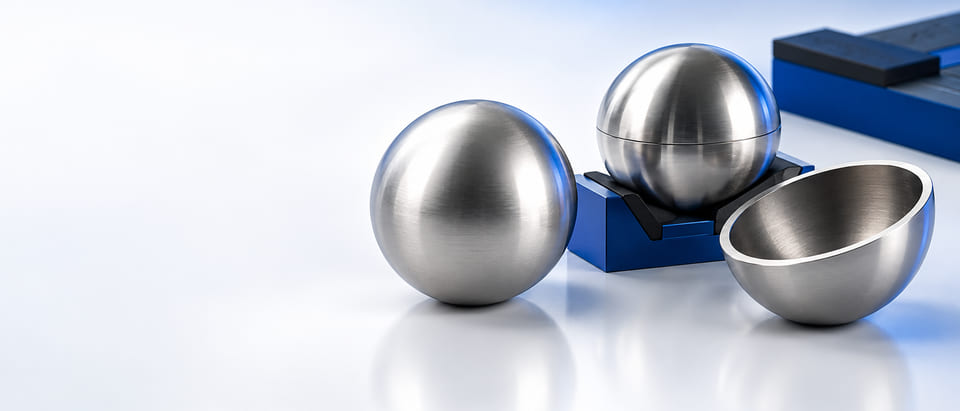
A matching outside diameter can hide a different engineering component. This guide compares hollow and solid stainless balls through structural requirements, transparent geometric calculations and the evidence needed for a useful quotation.
Quick Answer: When Should You Specify a Hollow Instead of a Solid Stainless Ball?
Choose a hollow stainless ball when reduced mass, buoyancy or a particular shell construction supports the component's function. Choose a solid ball when the design requires its specific material volume, contact behavior or precision route. Matching outside diameter does not make the two structures interchangeable. Wall geometry, seams, openings, leakage, surface condition and assembly loads can create different acceptance requirements.
A float, a handle, a decorative component and a rolling element may all look spherical, but they do not need the same evidence. A large polished hollow sphere should not be substituted for a precision bearing ball because the catalogue calls both products stainless balls. Conversely, a solid sphere may defeat the purpose of a mechanism that depends on low mass or net buoyancy.
For a MEITUO hollow-ball enquiry, describe the actual function, outside diameter, shell or mass requirements, attachment and environment. Define what the sample must prove. This guide helps separate structural choice from surface appearance so the quotation covers the relevant component rather than an incomplete spherical shape.
Which Functional Requirement Makes the Structure Important?
Start with the force or motion the component must produce. A float must displace enough fluid to support its own mass and the relevant mechanism. A handle or attachment must withstand its defined load path. A rolling contact needs a geometry and material condition suitable for its mating surface. These questions lead to different designs and inspection plans.
List operating and nonoperating conditions. A hollow float may encounter a different fluid density or pressure during cleaning, startup or shutdown. A lightweight sphere may experience handling impact that is more severe than its normal working contact. The structural choice must account for those conditions rather than only the most convenient demonstration.
Identify whether low mass is a preference or a functional limit. A buyer asking for a lightweight ball without a maximum mass or a system requirement leaves the supplier unable to distinguish an essential condition from a cost preference. Where the design remains open, share the mechanism and the available engineering constraint instead of inventing a wall thickness.
Keep the solid candidate equally specific. Solid describes construction, not a complete material or precision requirement. An alloy designation, finished condition, dimensions and relevant acceptance still need to be stated. The objective is a fair comparison between two defined components, not between one detailed drawing and one attractive product photograph.
How Do Outside Diameter, Wall Thickness and Seams Interact?
Outside diameter defines the external envelope, while the internal geometry determines how much material remains. Uniform nominal wall thickness is a useful model, but an actual construction can include a seam, local transitions, an attachment or an opening. Those features should be reviewed against the function rather than hidden behind a single outside dimension.
Specify the requirement that matters. If mass controls the mechanism, define mass acceptance and the relevant structural constraints. If a particular wall feature is essential, define where and how it is inspected. A few thickness readings should not be described as proof that every location is identical unless the method and requirement support that conclusion.
Seam and closure quality can affect leakage, appearance and local behavior. Agree the relevant acceptance separately: a visually smooth seam is not a leak test, and a leak-tight sphere does not automatically satisfy cosmetic or structural requirements. The drawing should distinguish those functions.
Do not use a simplified CGI cross-section as a manufacturing drawing. A concept image can explain the difference between shell and solid construction but cannot establish weld detail, allowable thinning or pressure capability. The order needs a reviewed geometry and evidence appropriate to the component's actual use.
Define whether a wall dimension is a nominal manufacturing input, a minimum at specified positions or another inspection requirement. Those alternatives are not the same contractual statement. A drawing that gives one thickness without identifying its role may create a dispute even if the supplier's process is internally consistent.
Likewise, a mass limit can support a functional requirement without fully describing the shell. Two spheres can have similar total mass while distributing material differently around a seam or attachment. If local behavior matters, a total-weight check needs the relevant geometric or structural evidence as well. The buyer should explain which condition could fail the mechanism so inspection focuses on that feature.
Separate an intentional opening from a leakage defect. Some constructions may include a hole for assembly, processing or another defined function. A closed-float requirement must identify what the finished condition is supposed to be, including any closure. Do not call an open development sample a failed leak-tight product if its quoted scope never included the final closure.
Hollow vs Solid Stainless Balls: What Should an OEM Compare?
Use the following matrix to identify different purchasing questions. It is not a load-rating table and does not imply that every hollow or solid construction follows one universal process.
| Question | Hollow candidate | Solid candidate |
|---|---|---|
| Mass | Actual shell construction and finished mass | Actual material volume and finished mass |
| Buoyancy | Displacement minus total component burden | Same calculation; solid construction may be unsuitable |
| Surface contact | Local shell and attachment behavior | Material condition and contact geometry |
| Leakage | Define closure and leak acceptance if required | Review any holes or attachments separately |
| Precision | Specify the achievable finished geometry | Specify the relevant finished geometry and grade |
The table deliberately separates structure from material family. A stainless choice that works in one atmosphere may be unsuitable in the actual fluid or cleaning environment. A change from hollow to solid also changes more than mass if the attachment, contact or manufacturing route changes.
When comparing prices, include the required seam presentation, finishing, dimensional inspection, leak test, packaging and sample approval. A hollow decorative offer and a functionally tested float are not equivalent merely because their outside diameters match. Require the quotation to identify which requirement is included and which remains unresolved.
How Can a Transparent Mass Calculation Compare the Structures?
Consider an explicitly hypothetical spherical shell with an outside diameter of 50 mm and an inside diameter of 48 mm. Using V = πD³/6, the outside volume is approximately 65,450 mm³ and the inside volume approximately 57,906 mm³. The idealized shell volume is therefore about 7,544 mm³, or 7.544 cm³.
Assume a material density of 8.0 g/cm³ solely for this illustration. The idealized shell mass is about 60.35 g, while a solid sphere with the same outside diameter would have a calculated mass of about 523.60 g. These are geometric estimates, not measured MEITUO weights, tolerance limits or recommended dimensions. Actual alloy density, seam material, thickness variation and attachments can change the result.
Use the estimate to organize the requirement, then verify the delivered component by the agreed method. A measured mass that differs from the model does not by itself identify a material defect; first confirm the actual geometry and included features. Conversely, an acceptable mass alone does not establish seam integrity or wall distribution.
Record assumptions alongside the calculation. If an engineer later changes outside diameter, inside diameter or alloy, update the estimate rather than reusing the old weight because the component still looks similar. A useful worksheet keeps inputs, units and the intended decision visible.
What Else Must a Float Application Validate Beyond Low Mass?
A float needs net buoyancy, not simply a hollow interior. The displaced-fluid contribution depends on external volume, fluid density and submerged condition. The mechanism also carries the sphere's mass and may impose attachment, friction or operating-force demands. Evaluate those burdens under the actual installation rather than treating floating freely in water as complete validation.
Using the same hypothetical 50 mm outside diameter, full displacement in a fluid assumed to have density 1.0 g/cm³ corresponds to about 65.45 g of displaced fluid. With an idealized sphere mass of 60.35 g, the remaining mass-equivalent margin would be about 5.10 g before attachments or mechanism forces. This small illustrative margin is not a recommended design; it demonstrates why actual mass and fluid density matter.
Leakage can reduce or eliminate the intended margin, while fluid density and temperature may vary during service. Define leak acceptance, test conditions and the consequence of an undetected leak. Do not infer a pressure rating from a buoyancy demonstration.
For another function, use another acceptance. A hollow handle or display sphere does not automatically need the same leak test as a float, but it may need its own attachment and impact validation. Match the evidence to the failure that the design must prevent.
The buoyancy model should also identify partial immersion. Full external volume is a convenient upper-bound geometric reference for a fully submerged sphere, not the displaced volume at every operating position. A mechanism that must move through a range needs its actual fluid level and force relationship reviewed at the relevant positions.
Express the result consistently. The earlier calculation used grams as a mass-equivalent comparison under the stated assumptions; actual buoyant force is a force quantity. Do not mix a force supplied in newtons with a burden entered in grams without the appropriate conversion and consistent physical model. Include the real operating conditions where gravity, orientation or fluid properties affect the analysis.
Finally, distinguish floating from actuation. A sphere that remains at a liquid surface may still fail to overcome a valve, linkage or friction requirement. The application owner should identify the needed movement and margin, then test the assembly. That preserves the useful role of the calculation without presenting a simple mass difference as a complete level-control design.
What Should a Hollow-Ball Drawing and RFQ Include?
Describe the component function, alloy, external geometry and the requirements that govern internal construction. Identify seam, closure, openings, threads or other attachment details. Add mass, surface presentation and any critical dimensional characteristics using defined units and acceptance methods.
Where leakage matters, state the relevant medium, pressure or other test condition, duration and acceptance rule. Do not request a generic waterproof certificate without explaining the component's actual duty. Structural and functional requirements may need separate engineering review, particularly if the design experiences pressure or consequential failure.
Provide quantities and the sample decision. A development sample should answer a defined question, such as fit, net buoyancy or attachment behavior, before the specification is released for recurring purchase. Record the conditions that the approval represents.
Protect the finished sphere during delivery. Contact dents, scratches and moisture exposure may affect appearance or function. Agree how parts are separated and labeled, and how a delivered lot connects to its inspection records. Clear packing requirements are especially useful for large thin constructions that can be damaged after the technical work has been completed.
How Should Hollow-Ball Buyers Compare China and Italy?
A hollow-sphere sourcing discussion should identify the function before selecting a supplier by location. This article uses China and Italy as examples because the useful comparison concerns engineered ball construction and the evidence behind the offer. It is not a ranking of national capability.
Treat every proposed sphere as a defined item. A catalogue that lists several ball constructions does not prove a particular mass, leak condition or size is available. Ask the intended seller to confirm the actual construction and approval scope.
China: a specification-led sourcing review
MEITUO Balls in Qingdao, China can be approached with a shell drawing, mass target and component function. If a float is intended, provide the fluid and mechanism burden rather than asking only for a light stainless sphere. If the requirement is cosmetic or structural, explain the applicable surface and attachment acceptance instead.
Record the quoted entity and the proposed source or processing scope where supplier qualification needs them. Preserve the approved sample's identity, including seam and attachment condition. A photograph should support communication, not replace the acceptance needed for the component.
Italy: compare the actual requirement
RGPBALLS in the Milan area is an identifiable Italian supplier example for researching ball-product options. Confirm whether its actual offer addresses the particular structure required; a broad product range is not a promise of a custom float construction.
Compare the same alloy, geometry, mass and test scope with a China-based proposal. Ask how the supplier reports any functional verification and how it protects the finished sphere in transit. If the commercial routes differ, keep logistics and repacking questions separate from the engineering comparison so a cheaper presentation does not conceal a different deliverable.
How Can MEITUO Help Define a Hollow or Solid Ball Requirement?
MEITUO Balls is the ball-focused website of Qingdao Meituo Steel Co., Ltd., based in Qingdao, China. For a structural ball enquiry, the useful conversation connects geometry, material and function rather than assuming the spherical exterior describes the whole component.
Bring a drawing or explain the mechanism. If the main issue is buoyancy, provide the fluid and mass burden. If it is an attachment, show the load path and mating feature. If appearance is important, define the surface and viewing acceptance. These inputs help distinguish a decorative or general-purpose sphere from a functionally evaluated component.
Review the hollow ball page and float and level-control application route, then prepare an enquiry with sample and production quantities. Supply feasibility, source, inspection and commercial terms need confirmation for the actual item.
Consider MEITUO as a China-based enquiry option when you need those requirements organized into a reviewable scope. Do not infer a factory arrangement, pressure qualification, stock weight or certified test capability from the existence of a product page. Confirm the evidence and responsibilities needed by your project before approving the purchase.
Hollow vs Solid Stainless Steel Balls FAQ: What Should Buyers Ask?
Can a hollow sphere replace a precision bearing ball?
Do not assume so. Structure, material condition, geometry and contact duty differ. The actual rolling-element requirement needs its own specified and validated component.
Does a polished seam prove leak tightness?
No. Surface appearance and leakage are different acceptance questions. Define a suitable leak test when the function requires it.
Can mass prove uniform wall thickness?
Not by itself. Mass reflects several inputs, including geometry, material and attachments. Specify wall-related evidence separately when it matters.
Does a hollow ball always float?
No. Net buoyancy depends on displaced fluid, actual mass, fluid density and the burden imposed by attachments or the mechanism.
Are the numerical weights in this guide product specifications?
No. They are explicitly hypothetical calculations using stated geometry and assumed density. Confirm actual component data and acceptance in the quotation.
What should a first MEITUO enquiry include?
Provide function, alloy, outside geometry, shell or mass requirements, attachments, environment, quantity and the sample acceptance question. Include leak or structural requirements where relevant.