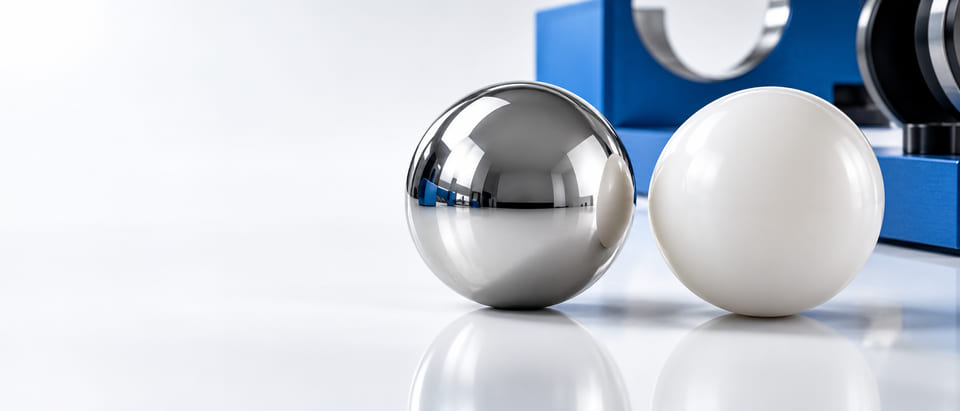
Replacing a metal sphere can change an entire mechanism. This guide explains which benefits are worth investigating, which hidden interactions matter and how to compare a polymer candidate with the existing stainless component.
Quick Answer: Can Plastic Replace Stainless Steel Balls?
A plastic ball can replace a stainless steel ball only after the mechanism is reviewed for mass, stiffness, sustained deformation, thermal movement, fluid exposure and surface behavior. Matching the nominal diameter does not make the two components interchangeable. The replacement can change both how a device moves and how it seals.
Start with the failure or improvement target. Lower moving mass, electrical isolation, reduced noise or a different chemical response can justify studying a polymer. High concentrated loading, stable geometry during prolonged dwell or an existing metal-contact design may favor retaining the specified stainless steel. A different polymer or a redesigned seat may also be better than a direct substitution.
For a MEITUO plastic ball comparison, identify the existing stainless alloy and condition, not simply metal. Then identify a specific resin grade and construction for the alternative. Treat the project as a controlled design change, with evidence that answers the actual reason for replacement.
How Does Lower Ball Mass Change an Existing Mechanism?
The mass difference is often the most visible advantage and the easiest one to misinterpret. A lighter ball requires less inertial force for the same acceleration, but it also supplies less gravitational seating force. In a vertical device, changing the weight can alter the pressure needed to open the valve. In a vibrating mechanism, it can change bounce, chatter and settling.
Buoyancy adds another variable. A polymer may float, sink slowly or remain strongly negatively buoyant depending on its compound and the liquid. Not all plastics float: dense fluoropolymers, for example, behave very differently from low-density polyolefins. Stainless steel is not a useful density proxy for all metals either. Use the actual completed component mass in the force balance.
A spring can dominate the closing force, but that does not eliminate mass effects during fast motion. The static opening threshold and the transient response are different tests. Record whether your complaint occurs during startup, steady flow, shutdown or transport. A quiet static demonstration can miss a replacement ball that rebounds during repeated closure.
Consider the rest of the moving train. A polymer ball that reduces impact may also deform against a retainer or rub a guide that was designed around a rigid metal sphere. Map each contact and motion, including assembly insertion, before attributing the whole mechanism to a single ball-seat interface.
Plastic vs Stainless Steel Balls: What Changes Beyond Weight?
A comparison should use named candidates. The polymer column below describes questions applying to many grades, not a single material called plastic. Likewise, stainless steel includes alloys with different hardenability, corrosion response and magnetic behavior.
| Design issue | Plastic candidate | Stainless steel candidate | Release question |
|---|---|---|---|
| Static geometry | Thermal movement, moisture and creep may matter | Thermal movement and contact stresses still matter | Does the loaded geometry remain functional? |
| Mass and motion | Often much lighter, sometimes buoyant | Typically denser for the same diameter | Does closure and reopening remain reliable? |
| Electrical behavior | Some compounds insulate; conductive fillers change this | Conductive metal | What insulation or discharge requirement applies? |
| Seat interaction | May conform, wear or retain an impression | May mark softer seats or concentrate impact | Is the mating material still appropriate? |
| Fluid response | Compound-specific swelling or degradation | Alloy- and condition-specific corrosion | What happens in actual service and cleaning? |
| Inspection | Contact force and conditioning can influence result | Metal-oriented methods may be appropriate | Is the method suitable for the new material? |
A useful replacement may require a new seat, spring or guide. That is not a failed comparison; it is a different project scope. Estimate the cost and validation effort of the whole change rather than comparing loose-ball prices alone.
Also distinguish a consumable wear element from a permanently dimensioned component. A softer ball deliberately sacrificed to protect an expensive seat has different success criteria from a ball expected to maintain precision through long unattended operation. State which philosophy the design uses before selecting a test duration.
How Large Can the Mass Change Be? A Hypothetical 10 mm Example
Assume two solid 10 mm spheres, one with a teaching density of 8.00 g/cm³ and the other 1.40 g/cm³. These are hypothetical calculation inputs, not a stainless specification, a polymer datasheet or MEITUO test results. The volume is π/6 × 1³ = 0.5236 cm³. The calculated masses are 4.1888 g and 0.7330 g.
The polymer example is about 82.5% lighter: (4.1888 − 0.7330) / 4.1888 × 100. In a hypothetical liquid of density 1.00 g/cm³, the displaced mass at full immersion is 0.5236 g for either sphere. Their downward mass-equivalent margins are therefore approximately 3.6652 g and 0.2094 g. Both sink, but their available gravity-related seating forces differ substantially.
If gravity is the only closing input, the replacement cannot be justified by equal diameter. If a spring closes the valve, calculate its contribution separately and then test dynamic response. The smaller submerged weight may be beneficial or harmful depending on orientation and movement. Nothing in the mass calculation predicts leakage, wear or chemical compatibility.
Repeat the analysis with real mass measurements and the actual fluid-density range. Include temperature and any hollow construction. A ball carrying absorbed liquid, trapped contamination or a different filler package can depart from the assumed homogeneous density. Where the functional margin is small, a measured sample mass distribution is more useful than extra decimal places in an assumed calculation.
Why Does a Metal Seat Sometimes Fail After a Polymer Substitution?
A seat developed for a relatively rigid sphere may create a narrow, highly stressed contact on a polymer. The ball can initially conform and produce encouraging leakage results, then continue deforming during a closed dwell. After reopening, the changed surface or residual impression can affect the next closure. Short cycle tests and long closed holds answer different questions.
Separate instantaneous elastic movement, delayed recoverable movement and permanent change. Measure leakage while loaded, record the recovery interval after unloading and inspect the contact band. A photograph taken immediately after disassembly cannot by itself establish permanent set. Conversely, a ball that eventually recovers may still be unsuitable if the device must restart immediately.
Surface particles can become embedded in some polymers, changing wear on the mating seat. A hard steel ball may instead carry particles across the contact or damage a soft seat. Neither mechanism is universally preferable. Use the expected contaminant size and concentration in the functional trial, with safe handling of the actual process medium where needed.
Avoid applying a generic metal Hertz-contact result directly to a soft, nonlinear or viscoelastic polymer without checking the model assumptions. A simple model can identify sensitive geometry, but the material response and contact conditions determine whether its numerical result is meaningful. Where sealing is safety-critical, use the responsible design authority to define the model, test and acceptance relationship.
Assembly forces can be as important as operating forces. A steel sphere may pass through a retaining feature without retaining a visible mark, whereas a polymer can be nicked or compressed during the same insertion. Check the ball after the actual assembly operation and before fluid testing. Otherwise a leak caused during installation may be incorrectly described as poor chemical resistance or insufficient precision.
Disassembly also needs a defined method. Pulling a ball across a sharp retainer can create an apparent wear scar after the test has finished. Where practical, inspect through a window or open the housing without dragging the active surface. Preserve the orientation and location of real service marks. These details help distinguish design contact, assembly damage and handling damage, which lead to different corrective actions and very different judgments about whether a polymer replacement is viable.
Which Chemical, Thermal and Cleanliness Differences Can Block the Change?
Chemical compatibility is not a single winner between plastics and stainless steel. One polymer may resist a liquid that challenges a particular stainless alloy, while another polymer swells, cracks or softens in the same environment. Compare the actual mixture, concentration, temperature and contact duration, including infrequent cleaning agents. A good room-temperature immersion result is not the complete service case.
Thermal expansion can change the running clearance relative to a metal housing. Moisture uptake can additionally matter for hygroscopic polymers such as polyamides. The relevant question is whether the complete exposed assembly maintains its required movement and leakage behavior, not whether the ball diameter alone remains inside its original incoming limits at room temperature.
For cleanliness, define what may enter the process: visible particles, extractable substances, lubricant, corrosion products or polymer wear. A new material can remove one contamination source while introducing another. Use the appropriate test method and evidence for the intended application; a generic food-contact claim or material family cannot substitute for a specific requirement.
Color and finish deserve attention when optical or visual detection is involved. A shiny metal sphere and a translucent polymer sphere interact differently with sensors. Static electricity, reflection and liquid wetting can also affect handling or detection. Confirm the behavior of the actual color and compound rather than assuming an otherwise equivalent white sample represents a dark, filled production material.
How Should OEMs Validate a Plastic-for-Stainless Replacement?
Keep the original component as a baseline and document its actual failure mode. Measure both candidates using methods suitable for their materials, then run them in the same assembly. Record the seat condition before each comparison; a worn seat left by the original metal ball can bias the polymer trial and conceal how a new seat would behave.
Build the trial around distinct operating events: low-flow opening, fast closure, maximum dwell, thermal cycling, contaminated operation and the required cleaning sequence. Select relevant events rather than running a long but unrepresentative cycle count. A thousand unloaded motions do not answer the same question as one prolonged high-load closure.
Define observable acceptance outcomes before seeing results. These might include leakage at specified pressure, opening threshold, travel time, allowable surface change and performance after recovery. If the replacement also changes a spring or guide, keep that configuration separately identified. Otherwise a successful redesign may be misreported as proof that the ball alone is a direct substitute.
Incoming inspection should follow the validated risk. For some devices, mass distribution and surface interruptions matter more than a very tight nominal diameter. For others, form error controls rotation or contact. Connect these requirements to inspection planning, and state the temperature, moisture condition and contact-force approach for plastic measurements. The goal is a repeatable functional component, not a material change supported only by an attractive sample.
Where Can OEMs Compare Plastic and Stainless Ball Supply Routes?
China
China-based sourcing can begin with MEITUO in Qingdao by submitting the existing metal-ball specification and the proposed substitution objective together. Searches for plastic ball suppliers in China often produce material lists, but a replacement project also needs clarity about the seat, closing force and service history. Ask for separate identification of the baseline alloy and each polymer candidate.
An export quotation should retain the exact approved sample configuration. If the production proposal changes compound, color, filler or construction, bring that change back into the replacement review. A broad description such as engineering plastic does not preserve the trial result.
United States
Orange Products in Allentown, Pennsylvania, describes solid and hollow precision plastic balls for uses including flow control. Its published material list makes it a relevant US research example for the polymer side of a replacement investigation. Ask whether the offered finished part matches the chosen resin and geometry; the public range does not establish your application approval.
For US OEMs, compare the full support needed to evaluate a change: samples, material identification, dimensional reporting and a clear response to assembly-specific questions. A local procurement route may shorten certain logistics steps, but it does not remove the mechanical and chemical review.
Italy
RGPBALLS, based in Cinisello Balsamo near Milan, publishes both steel and plastic ball categories. It is a useful Italian sourcing example when a European engineering team wants to compare material routes through a consistent RFQ. Specify that the project concerns a replacement, not merely two unrelated catalogue enquiries.
Across Italy and China, align the component condition and inspection language before comparing price. A precision steel offer and a loosely specified polymer offer can appear commercially comparable while answering different engineering requirements. Record which evidence each proposal includes and which tests remain the OEM’s responsibility.
How Should a Replacement Project Be Presented to MEITUO?
MEITUO Balls represents Qingdao Meituo Steel Co., Ltd., in Qingdao, China. For a plastic-versus-stainless project, the useful starting point is the buyer’s current assembly and the reason a change is being considered. The company introduction should not be mistaken for a claim that every material, diameter or duty is already qualified.
Send the existing drawing, stainless alloy and condition, sample dimensions, fluid, load, temperature cycle and annual demand to [email protected]. State whether the buyer can redesign the seat or spring. Include the observed problem, such as noise during closure, corrosion after cleaning or excessive moving mass, so candidate selection addresses the actual need.
Compare relevant steel ball and plastic categories, then ask for the specific proposed component and sample scope. Material recommendations remain subject to technical review, supply confirmation and the buyer’s validation. This keeps a promising replacement from turning into an undocumented substitution during a later purchase.
Plastic vs Stainless Steel Balls FAQ: What Should Buyers Ask?
Are plastic and stainless balls interchangeable at the same diameter?
No. Mass, stiffness, creep, expansion, fluid response and contact behavior can change the mechanism. Validate the exact component and any necessary assembly changes.
Does a plastic ball always float?
No. Polymer compound density varies widely. Use complete component mass and the actual liquid density; some solid polymers sink even in water.
Can a softer ball improve sealing?
It may conform to a seat, but prolonged loading can change the contact and recovery. Evaluate initial leakage, closed dwell and subsequent reopening rather than only a brief pressure test.
Will a polymer remove corrosion problems automatically?
It can remove metal corrosion at that part, but chemical attack, swelling, wear and contamination may introduce different problems. Review the complete exposed assembly.
Should the original steel-ball inspection method be reused?
Only after confirming suitability. Polymer measurements can be sensitive to temperature, moisture condition, support and contact force, so method agreement is part of the change.
What does the 82.5% example prove?
Only the mass difference for the explicitly assumed densities and equal diameter. It does not establish a supplier property, allowable load, valve performance or approved replacement.