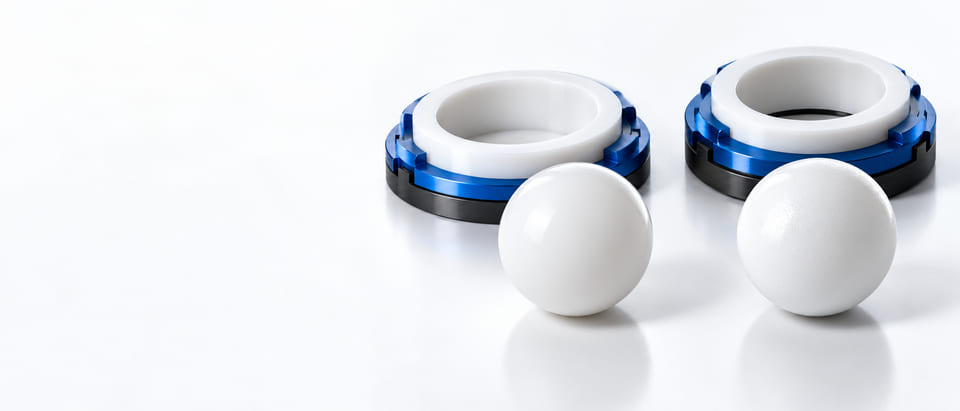
Choosing a white polymer ball by appearance misses the variables that control a dosing valve. PVDF and PTFE can both enter a chemical-service shortlist, but their different mechanical responses and densities need to be evaluated in the actual ball-and-seat assembly.
Quick Answer: Should You Choose PVDF or PTFE Dosing Balls?
Choose between PVDF and PTFE balls by the actual chemical mixture, temperature, ball movement and loaded seating behavior. PVDF can be attractive when greater stiffness or abrasion resistance is needed; PTFE is often considered for broad chemical resistance and low-friction contacts. Neither description proves a particular dosing valve will prime, meter accurately or remain leak-tight.
Start with two identified formulations and the same finished drawing. Compare effective submerged weight, clearance, seating force, pressure reversal and deformation after dwell. A polymer compatibility chart is a screening aid, while the complete wetted assembly needs a defined functional test. MEITUO’s ball material-selection discussion can begin with these conditions rather than a request for an unspecified chemical-resistant sphere.
For low-flow systems, specify the smallest intended dose and slowest operating condition. A ball that closes reliably at one generous flow may behave differently during suction, intermittent operation or near-zero differential pressure. Treat chemical survival and repeatable dosing as separate acceptance questions.
What Material Differences Matter in PVDF vs PTFE Balls?
PVDF and PTFE are different fluoropolymer families, not interchangeable descriptions of the same resin. Relative stiffness, wear behavior and resistance to deformation influence how the ball contacts its seat. PTFE can conform under sustained loading; that may help one contact close while changing geometry in another. A comparatively stiffer proposal can retain shape differently yet require a more suitable seat finish and closing condition.
Ask whether each proposal is unfilled, modified or compounded. A resin abbreviation on a quotation does not identify additives, processing route or finished-ball history. The comparison should include the exact material designation offered, size range and which dimensions are actually controlled. Typical properties from a stock-shape or resin datasheet are not automatically finished-ball acceptance limits.
Map the failure mechanism before ranking materials. If the current failure is a worn seat, changing only the ball may transfer wear rather than remove it. If the ball sticks because precipitated solids bridge the guide, a different resin may leave that mechanism unchanged. Where the issue is prolonged compression, short-duration hardness readings will not answer the relevant question.
Use a material decision sheet with four columns: observed failure, proposed material mechanism, evidence required and unacceptable side effect. For example, a stiffness change intended to reduce ball flattening must also be checked for reverse leakage and mating-seat damage. This turns a material comparison into a testable engineering proposal rather than a list of unrelated catalogue advantages.
How Does Fluid Density Change Ball Closing Behavior?
A ball’s weight in air is not its effective weight in a liquid. Buoyancy subtracts from the gravitational force available to move a fully submerged ball. The importance depends on valve orientation, spring force, pressure difference, viscosity and acceleration; it cannot be reduced to the statement that the heavier material always seals better.
For an illustrative calculation, assume a 10.00 mm sphere, liquid density 1.20 g/cm³, and hypothetical candidate densities of 1.78 g/cm³ and 2.18 g/cm³. The sphere volume is πd³/6 = 0.5236 cm³. Subtracting the displaced-liquid mass gives effective mass equivalents of (1.78−1.20)×0.5236 = 0.3037 g and (2.18−1.20)×0.5236 = 0.5131 g. The difference is approximately 0.2094 g. These are assumed inputs, not MEITUO material values or closing-force specifications.
The example helps identify a possible mechanism; it does not predict response time or opening pressure. In a spring-loaded horizontal valve, the spring and pressure forces may dominate. In a gravity-assisted vertical valve with a dense chemical, buoyancy can be more important. Gas bubbles, incomplete wetting and fluid deposits complicate the simple model.
Record ball orientation and the actual fluid temperature when measuring return behavior. If testing uses water while service uses a denser concentrate, document that mismatch and resolve it before drawing a dosing conclusion. Changing ball diameter changes volume with the cube of diameter, but also changes clearances and contact geometry; it is not a free way to add weight.
PVDF vs PTFE: Which Questions Should a Comparison Table Answer?
A useful comparison separates a material tendency from the evidence needed for this valve. There is no single combined chemical-and-mechanical score that safely ranks every formulation. The table below is a planning tool; its entries identify questions rather than guaranteed performance values.
Give each candidate its own identification code. Use that code on the sample container, drawing review, exposure sheet and valve test. If a supplier changes the formulation during development, open a new candidate record. Otherwise an attractive result can become detached from the material later purchased.
In particular, distinguish dimensional recovery from permanent change. A ball measured immediately after removal from a loaded hot assembly may not represent its relaxed room-temperature state. Record the elapsed time and conditioning before every comparison. The drawing should say which state governs acceptance.
Do not hide unresolved requirements in a weighted score. A candidate with excellent price and delivery cannot offset failure of a mandatory leakage limit by earning more commercial points. First apply mandatory technical gates; then compare the acceptable proposals commercially. If both candidates fail, revise the design or scope of the search rather than declaring the less poor result a qualified material.
| Decision | PVDF candidate | PTFE candidate | Evidence needed |
|---|---|---|---|
| Seated deformation | Review exact stiffness and contact response | Review time-dependent conformity and creep | Loaded dwell plus recovery measurements |
| Chemical exposure | Check actual mixture and cleaning fluids | Check resin and any modifier or filler | Exposure record and retained function |
| Low-flow movement | Evaluate submerged weight and guide contact | Evaluate submerged weight and friction | Priming, restart and minimum-dose trials |
| Wear and contamination | Inspect ball and mating seat | Inspect ball and mating seat | Debris assessment and pair-level inspection |
How Should Chemical Compatibility Be Tested for Dosing Duty?
Write the exposure as a recipe, not a chemical name alone. Include concentration, water quality, additives, dissolved or suspended solids, temperature range and likely contamination. A diluted process fluid and its concentrated cleaning solution can present different demands. Intermittent exposure, trapped fluid during shutdown and alternating chemicals also deserve separate entries.
A practical screening plan retains unexposed controls and identifies the specimens before immersion. Record initial mass, dimensions and surface condition using an appropriate measurement method. After the agreed exposure, follow a defined cleaning and conditioning procedure before measuring again. If a residue remains on the ball, distinguish that residue from a change in the polymer instead of interpreting every mass increase as absorption.
The screen should include the actual proposed seat or representative mating material where interaction matters. Dissimilar swelling, softening or surface change can impair the assembly even when the ball alone looks acceptable. If the system requires extractables or product-purity assessment, dimensional stability is not a substitute for the relevant analytical work.
Reserve specimens for a second measurement when the first result is ambiguous. For example, a removable crystalline deposit can explain apparent diameter growth without demonstrating polymer swelling. Photograph the as-removed condition, document the permitted cleaning step and keep the original observation in the record. If cleaning itself changes the surface, use a separate control to investigate that effect. Do not repeatedly clean and remeasure until the specimen happens to meet a limit; the procedure and allowed repetitions should be agreed beforehand.
Set pass criteria before viewing the results. Avoid an after-the-fact rule such as no visible damage when the original problem concerned microliter-scale leakage. A finite exposure supports a conclusion about those specimens under those conditions. It does not establish unlimited chemical life, compatibility with all concentrations, or the lifetime performance of a different formulation.
Which Valve Tests Separate Material Survival from Metering Quality?
Run the functional comparison at defined pressure, temperature and viscosity conditions with the same pump settings. Useful endpoints include priming attempts, time to resume dosing after a pause, reverse leakage and delivered volume over an agreed interval. Where the equipment has an approved test method, use that method rather than inventing an unrelated bench ranking.
Repeat the smallest intended dosing condition, not only the easiest high-flow setting. A ball can pass a static reverse-pressure test yet respond too slowly during dynamic cycling. Conversely, an assembly may deliver a reasonable average while individual pulses become inconsistent. The application determines which of those outcomes matters.
Include a controlled shutdown dwell. Record whether the seat remains loaded, whether the liquid cools or crystallizes, and how the system is restarted. Examine ball and seat together afterward. A circular witness mark is evidence of contact, but its existence alone does not establish harmful deformation or acceptable sealing.
Where results differ, change one factor at a time. Replacing the ball, seat and spring simultaneously may produce a successful new assembly without showing that PVDF or PTFE alone solved the problem. Keep a configuration matrix so each result identifies the complete tested arrangement. Define stop conditions for sticking, unexpected debris or unstable dosing; repeated cycling after a failure can destroy the evidence needed to understand it.
What Should a PVDF or PTFE Ball Enquiry Actually Specify?
Describe the ball as a component within a dosing duty. Provide nominal diameter, dimensional requirements, available guide clearance and the seat drawing or contact description. Add pressure direction, cycling rate, maximum static dwell and the chemical-temperature envelope. Flag requirements that are mandatory and identify values that are still development assumptions.
Ask which proposal is being quoted: exact resin or formulation, construction, finishing, sample basis and available inspection records. Where a polymer grade is not yet selected, request clearly identified alternatives instead of allowing the supplier to choose an unspecified equivalent. If traceable resin identity is essential, confirm that requirement before ordering rather than after receiving samples.
Agree packaging that preserves sample identity and avoids contamination or damaging contact during transport. A clean-looking ball in a mixed bag is not a useful qualification specimen if the material or lot cannot be established. Receiving instructions should distinguish material identity, dimensional conformity and completed application testing.
For repeat supply, retain the approved configuration and test reference. A change to the fluid, minimum dose, seat material or operating temperature may reopen the comparison even if the ball drawing is unchanged. The goal is a repeatable purchase decision tied to a defined application, not a permanent claim that one fluoropolymer is universally superior.
Where Can Buyers Discuss PVDF and PTFE Dosing-Ball Supply?
Different sourcing routes can answer different parts of this comparison. A finished-ball supplier should address the proposed component; a pump manufacturer’s instructions address the approved assembly. Keep those roles explicit when obtaining local technical support or comparing international quotations.
China: Qingdao, Shandong
MEITUO Balls offers a China-based enquiry route for a defined PVDF-versus-PTFE review. Send both candidate requirements with the chemical mixture and seat context. Ask for the proposed material identity, sample scope and records to be confirmed for the actual order. For an OEM importing from China, align sample labels and drawing revisions with the receiving team before the qualification shipment leaves.
Italy: Cinisello Balsamo, Milan
RGPBALLS publishes separate PVDF and PTFE ball pages from its Cinisello Balsamo headquarters. This provides a finished-ball catalogue route for an Italian or European sourcing discussion. Ask whether the specific formulation, diameter and surface requirement can be offered. Compare on the same low-flow and dwell conditions as other proposals; the catalogue families alone do not establish interchangeability.
Denmark: Bjerringbro
Grundfos is a dosing-equipment manufacturer headquartered in Bjerringbro. Its model-specific literature provides an equipment route for identifying valve components and service constraints. An installed-pump buyer should first establish the permitted assembly and replacement procedure. That equipment role is distinct from buying a loose ball against an OEM drawing, and it should not be interpreted as an offer for arbitrary PVDF or PTFE spheres.
Before choosing a route, check who will own the ball specification and who will approve the complete dosing function. A nearby service contact can simplify troubleshooting, but does not establish that a material substitution is authorized for an installed pump.
How Can MEITUO Support a Defined Dosing-Ball Comparison?
MEITUO Balls is the ball-focused website of Qingdao Meituo Steel Co., Ltd., based in Qingdao, China. Its published company profile describes a specialty-steel background. For an engineering-polymer enquiry, the offered source, formulation, size and inspection scope should be established for the specific requirement.
The most productive brief explains why the current dosing contact is under review: deformation, chemical change, inconsistent movement or a sourcing problem. Include the observations and photographs, not just a preferred replacement material. This allows the discussion to separate the requested component from the unresolved system behavior.
Use the sampling and validation route to identify what a sample is intended to prove. Send the drawing and dosing conditions through the quotation page or [email protected]. Keep supplier component evidence alongside the OEM’s valve-performance decision; the two records answer complementary questions.
PVDF vs PTFE Balls FAQ: What Should Buyers Ask?
Are PVDF balls always harder or better than PTFE balls?
No. Relative mechanical behavior depends on the exact formulations and test conditions. A stiffer candidate may reduce one deformation mechanism while changing seat contact. Compare the actual proposals under the loaded duty and inspect both ball and seat.
Can I use a chemical-resistance chart as final approval?
A chart helps screen candidate materials. Final approval needs the actual mixture, concentration, temperature, exposure time and functional requirement. Cleaning fluids, additives and the mating parts must also be considered.
Why can a denser ball still cause poor low-flow dosing?
Higher density changes submerged weight, but dosing also depends on pressure reversal, spring force, guide friction, viscosity and response time. Weight alone cannot predict priming or metering performance.
Should the valve be tested after a long shutdown?
Yes, when shutdown is part of the intended duty. Define the loaded dwell, fluid condition, temperature change and restart method. Compare recovery and dosing behavior with an appropriate unexposed or previously approved control.
Is a ball surface mark proof that the material failed?
Not by itself. Identify its location, dimensions and relation to the sealing contact, then compare it with the agreed surface criterion and functional result. Contact evidence, damaging deformation and unrelated handling marks are different findings.
What information should I send to MEITUO first?
Send ball and seat dimensions, fluid recipe, temperature, pressure direction, minimum dose, cycling and dwell conditions. Explain the observed failure and request confirmation of candidate formulation, sample identity and the proposed evidence for the order.