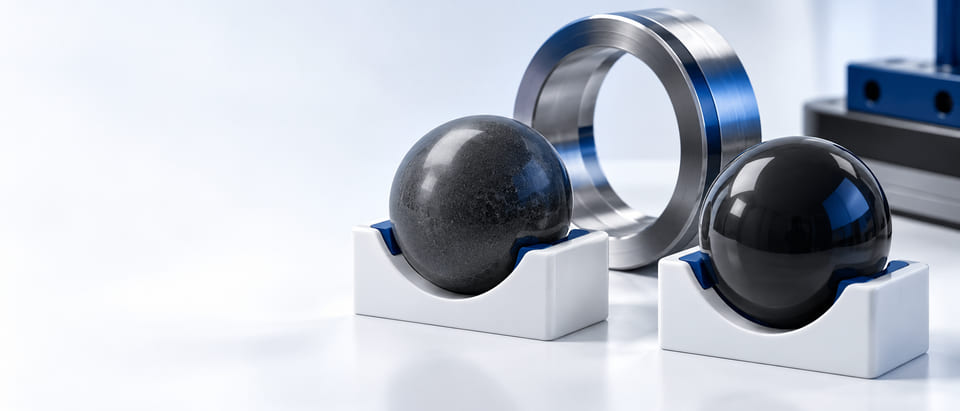
Silicon carbide and silicon nitride can both enter a demanding ceramic-ball shortlist. Their similar-looking chemical names do not imply the same electrical, thermal or contact behavior. A correct comparison starts with the exact grade and the property that controls the mechanism.
Quick Answer: Are SiC and Si3N4 Balls Interchangeable?
No. Silicon carbide, SiC, and silicon nitride, Si3N4, are different ceramic families with different formulations and processing routes. SiC can offer attractive hardness, rigidity and thermal behavior; Si3N4 is often considered for its combination of toughness, thermal-shock behavior and dynamic-contact applications. Those tendencies are screening reasons, not universal finished-ball ratings.
Electrical behavior needs explicit verification. Some SiC formulations are engineered for particular resistivity ranges, including relatively conductive behavior. Do not describe every ceramic ball as an insulator or infer an assembly’s electrical protection from the chemical family alone.
Use MEITUO’s material-selection discussion to define the actual electrical, chemical, thermal or mechanical requirement. Identify the proposed grades, finished geometry, mating contact and operating conditions. A material datasheet can guide the shortlist; the purchased sphere and complete assembly need evidence appropriate to their respective requirements.
Which SiC and Si3N4 Grades Should the Buyer Identify?
SiC includes directly sintered, reaction-bonded, liquid-phase-sintered and chemical-vapor-deposited material routes, among others. Their compositions and microstructures can differ substantially. Reaction-bonded material can contain a silicon phase associated with its process, while a CVD proposal represents another material route. The generic SiC label does not preserve those distinctions.
Si3N4 also includes different forming, sintering and densification routes. Grain structure, additives, residual phases and processing influence the resulting properties. A ball intended for a particular bearing duty should not be replaced by any sphere described only as silicon nitride without the relevant grade and component requirements.
Request the actual offered designation and which properties are typical guidance versus purchased limits. A ceramics producer’s broad material table may compare flat or standardized specimens; it does not automatically establish the geometry, surface integrity or allowable duty of a particular finished ball.
A surface treatment or coating adds another identity field when it affects the function. Establish whether the requirement concerns the bulk ceramic, the treated surface or both. A bulk property table cannot automatically characterize a changed surface layer, and a coating result does not establish the underlying ceramic’s complete behavior.
Keep grade and finished-source identity together. If a sample is obtained from a material route different from the proposed repeat supply, document that difference before relying on its results. A successful component should have a reproducible material and processing basis. Color, shine and nominal density can support observations, but are not a sufficient method to establish the exact formulation or production history.
Why Is “Ceramic Means Electrical Insulator” an Unsafe Assumption?
Electrical resistivity varies by ceramic composition and can depend on temperature, environment and processing. Official SiC material information includes grades with deliberately different volume resistivities. This is a concrete reason to specify the required electrical behavior rather than assume it from a nonmetallic appearance.
Distinguish volume resistivity, surface resistivity, resistance and dielectric strength. They answer different questions and use different units and geometries. A high resistance measured in one setup does not establish a dielectric withstand capability at the assembly’s voltage, frequency, contamination and temperature.
An electrical record should identify specimen geometry, electrode arrangement, test voltage or field basis, temperature, humidity or conditioning and the distinction between surface and bulk contributions where relevant. If a laboratory uses a witness coupon, record how its material and processing relate to the offered ball. A coupon result may help establish a material input while leaving the actual sphere-contact path and assembly requirement unresolved. Avoid copying an instrument reading into a material-resistivity field without the necessary geometry and method.
The complete electrical path includes more than the ball. Lubricant, surface contamination, moisture, surrounding components and contact geometry can affect the system. A material property can support a design calculation, but the owner of the electrical requirement must determine the relevant component and assembly test.
For a hypothetical witness coupon, assume volume resistivity 10⁸ Ω·cm, equivalent to 10⁶ Ω·m. With a uniform current path length of 0.002 m and cross-sectional area 25×10⁻⁶ m², the idealized bulk resistance is R = ρL/A = 80×10⁶ Ω, or 80 MΩ. These are invented inputs for a simple coupon model, not SiC data, a ball test or an insulation guarantee. A sphere’s contact geometry and surface paths require a different justified treatment.
SiC vs Si3N4: Which Technical Trade-Offs Need Their Own Evidence?
Keep electrical, thermal, chemical and mechanical requirements as separate gates. One candidate may look attractive for heat transfer while another offers a useful dynamic-contact combination. Neither advantage cancels failure of a mandatory chemical or electrical endpoint.
Published SiC grades can show different thermal conductivities and resistivities within the same family. Si3N4 grade tables also vary. Compare exact materials at relevant temperatures rather than treating a family average as a guaranteed value. A supplier’s maximum-use temperature is not the operating rating of a ball in a lubricated bearing or custom valve.
Hardness, toughness and stiffness should remain distinct. A high-hardness contact can still suffer brittle damage from an unfavorable edge or particle. A tougher material does not automatically protect a soft mating surface from wear. Inspect the pair and identify the failure mechanism being addressed.
Commercial evaluation follows technical acceptance. Normalize the quotation to the same accepted piece count, geometry, surface criteria and evidence scope. A material with a prestigious application history may still be unnecessary for the buyer’s actual duty. Conversely, a cheaper nominally similar ceramic is not equivalent if its electrical or processing identity differs from the approved grade.
| Requirement | SiC candidate | Si3N4 candidate | Evidence needed |
|---|---|---|---|
| Electrical behavior | Identify exact resistivity class and conditions | Identify exact grade and relevant electrical properties | Material plus required assembly evaluation |
| Thermal duty | Check grade-specific heat transfer and expansion | Check grade-specific expansion and shock behavior | Actual temperature sequence and constraints |
| Chemical exposure | Review composition and residual phases | Review additives and relevant phases | Specific mixture, time and temperature |
| Mechanical contact | Assess hardness, stiffness and brittle damage | Assess toughness and dynamic-contact suitability | Finished geometry and pair-level test |
How Should Thermal Shock Be Separated from High-Temperature Survival?
Uniform exposure at temperature and a rapid temperature change create different questions. Thermal shock depends on temperature gradients, geometry, heat transfer and material properties. A ball’s surface and center may not follow the same temperature history, especially during immersion, cleaning or rapid restart.
Si3N4’s low expansion and mechanical-property combination make it a common thermal-shock candidate, but the exact grade and assembly still matter. SiC can have attractive thermal conductivity, which affects heat distribution, yet a high-conductivity number alone does not establish immunity to shock. Surface damage, constraints and mating materials can change the outcome.
Define the thermal sequence: initial state, heating or cooling medium, transfer time, dwell, force state and required function afterward. If the system includes a metal guide, seat or race, account for its movement and constraints. A free sphere exposed in an oven is not the same configuration as a retained ball under load.
Measure or justify the temperatures relevant to the contact. A chamber setpoint may not represent the sphere during a transition. After the sequence, inspect local surface damage and verify the intended function, not only the absence of visible separation. A successful finite thermal trial should retain its conditions and scope; it does not justify arbitrary faster quenching, higher temperature or a universal life extension.
Which Chemical and Contact Conditions Can Reverse the Shortlist?
Chemical compatibility is specific to composition, medium and exposure. The base ceramic, sintering additions or residual phases may respond differently. A claim that a material family is corrosion-resistant should lead to an exact-grade review, not replace one.
Specify fluid composition, concentration, contaminants, temperature, pressure where relevant and exposure duration. Include cleaning and shutdown conditions. If purity matters, define the relevant release or contamination requirement separately from visible corrosion. A surface can remain apparently smooth while an analytical endpoint is unacceptable.
For mechanical contacts, identify counterpart, finish, geometry, load, speed and lubrication. A ceramic candidate selected for one contact type may perform differently in another. Edge loading, misalignment and hard particles can introduce localized stresses that a general material-strength table does not describe.
In a bearing-related project, the entire bearing system needs review: rings, clearance, lubrication, cage, assembly and intended operating duty. A loose ball’s material or dimensional report does not establish bearing speed, life or electrical protection. For a valve, preserve the seat and pressure sequence instead of inferring sealing from polished appearance.
If a candidate changes the failure location, document that honestly. Less ball wear with greater seat or race damage is not automatically an improvement. Inspect and evaluate the complete relevant pair before deciding that a family-level property has solved the application.
What Qualification Tool Prevents Unsupported Ceramic Substitutions?
Use a property-to-function ledger. For each claimed advantage, enter the exact material, source of the property, relevant service condition, expected mechanism and required component or assembly evidence. Mark whether the entry is a typical value, a measured sample result or a purchased limit.
For example, a resistivity entry should identify temperature and measurement basis and should lead to the actual electrical requirement. A thermal-shock entry should lead to a defined temperature sequence and function check. A wear entry should identify the counterface and motion. This prevents unrelated favorable numbers from becoming a general suitability conclusion.
Consider a development ledger with two different applications. In an electrically sensitive contact, the required resistivity behavior may be a mandatory gate; a SiC candidate selected for thermal conductivity cannot bypass that gate. In a chemically exposed mechanical contact, a candidate may satisfy the electrical question but still need formulation-specific exposure and seating evidence. The same two chemical families can therefore lead to different shortlists without either conclusion being contradictory.
The ledger should also distinguish missing evidence from adverse evidence. A blank electrical field means the requirement remains unresolved; it does not prove insulation or conductivity. An actual result outside the agreed limit is a different disposition. Similarly, an untested chemical mixture is not the same as a demonstrated incompatibility. This distinction helps the team decide whether the next step is obtaining data, testing an identified proposal or rejecting a candidate. It also prevents sales language such as suitable for severe service from quietly filling gaps in the technical record.
Test identified specimens against pre-agreed endpoints. Preserve the finished-ball drawing, initial surface, material record and complete configuration. Use appropriate controls or replicates for the decision, and state the sample limitations. Repeated measurements on one ball do not establish variation across independent production parts.
At handover, retain the accepted grade and processing scope with the evidence ledger. A change between directly sintered and reaction-bonded SiC, or to another Si3N4 grade, should not be accepted as the same material merely because the formula remains familiar. Review what can affect the approved function. A bounded trial deviation can support learning without silently rewriting the series-order specification.
Which Regional Routes Support SiC and Si3N4 Ball Enquiries?
Advanced-ceramic material expertise and finished-ball sourcing contribute different pieces of the decision. Ask each route for evidence within its actual role, and use one common ledger to connect material properties with the finished contact.
China: Qingdao, Shandong
MEITUO Balls can receive a China-based ceramic enquiry with the exact electrical, thermal and mechanical requirements. Include the mating geometry and distinguish confirmed limits from development assumptions. Ask for the proposed grade, source and sample scope to be established for the actual order. A request for ceramic insulating balls should identify the real electrical endpoint rather than presume a material-family answer.
Italy: Cinisello Balsamo, Milan
RGPBALLS publishes SiC and Si3N4 ball categories from its Cinisello Balsamo headquarters. This is a finished-ball sourcing route in Italy. Confirm the actual grade, process, size and records offered for the requirement. Compare the same contact and exposure sequence across suppliers instead of treating the published chemical formulas as complete interchangeable specifications.
United States: Golden, Colorado
CoorsTek is headquartered in Golden and publishes distinct silicon-carbide and silicon-nitride technical information. Its SiC information explicitly distinguishes process and resistivity options, making it a useful exact-material discussion route for a US engineering team. Confirm the particular component scope directly; broad material guidance should not be transferred into an assumed finished-ball rating or availability claim.
When comparing regional offers, confirm the exact material route, offered sphere size and required records. A company’s ceramics portfolio is not proof that every grade is available as a precision ball, and a ball catalogue does not establish the application’s electrical or thermal-shock approval.
How Can MEITUO Help Frame an Exact-Grade Ceramic Request?
MEITUO Balls is the ball-focused website of Qingdao Meituo Steel Co., Ltd., in Qingdao, China. Its published company profile describes a specialty-steel background. A specialist ceramic proposal requires the actual grade, source, finished size and available evidence to be confirmed for the enquiry.
Send the property-to-function ledger with the drawing. Explain whether the controlling issue is electrical behavior, thermal transition, chemical exposure or contact damage. Include any accepted baseline and identify which properties still need substantiation. This makes the proposal specific enough to compare without promising that one ceramic family solves every requirement.
Use the sampling and validation route to organize candidate identity and the trial sequence. The quotation page or [email protected] can receive the drawing and quantities. Preserve the exact accepted material and configuration with the order, while the complete application approval remains connected to its own evidence.
Silicon Carbide vs Silicon Nitride Balls FAQ: What Should Buyers Ask?
Are all SiC balls electrical insulators?
No. SiC formulations can be engineered for different resistivity ranges, including relatively conductive behavior. Specify the exact grade and electrical requirement, and assess the complete relevant assembly.
Is silicon nitride the same material as silicon carbide?
No. Si3N4 and SiC are different ceramic families with different formulations and processes. Their mechanical, thermal, chemical and electrical properties must be compared on an exact-grade basis.
Does high thermal conductivity prove good thermal-shock performance?
Not alone. Thermal shock also depends on expansion, mechanical behavior, geometry, gradients, constraints and surface condition. Use a representative temperature sequence and functional assessment.
Can a material maximum-use temperature rate a bearing?
No. A bearing includes rings, clearance, lubrication, cage and other constraints. A loose-ball material property does not establish complete bearing speed, life, temperature or electrical protection.
Are volume resistivity and dielectric strength interchangeable?
No. They describe different electrical behavior and require different methods and interpretation. State the required property, units, conditions and component or assembly test scope.
What changes should trigger review of an approved ceramic ball?
Review changes that can affect the accepted function, including grade, composition, processing route, finished geometry, surface, counterface or duty. A familiar chemical formula alone does not establish equivalence.