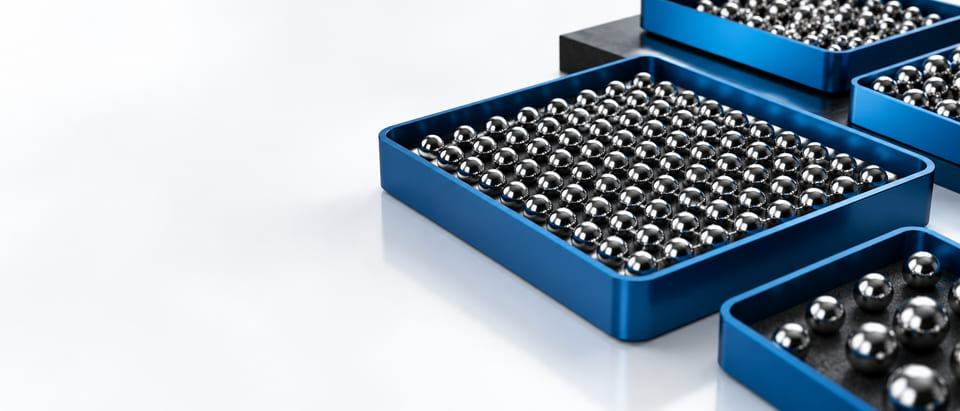
Tiny parts can create a large traceability problem before the first dimension is measured. A disciplined receiving process protects the connection between the labelled container, working sample and eventual release decision.
Quick Answer: How Should Small Steel Balls Be Inspected Without Losing Identity?
Identify and separate the delivered containers before opening, label the working sample and record every transfer and disposition. Apply suitable dimensional and surface checks under the agreed plan. Treat counting by weight as a controlled estimate with a verified mean-mass basis, not proof of an exact quantity or complete lot conformity.
Send the container labels, sample path and disputed measurement to MEITUO through the small-component inspection route. Keep a quantity estimate separate from a decision about material identity or dimensional acceptance.
Why Does Small Steel Ball Inspection Begin with Container Identity?
Small spheres are easy to move between containers and difficult to distinguish by appearance. The first receiving task is therefore preserving the connection between packaging, material, size, lot and purchase reference. Once two similar-looking quantities have been mixed, a good measurement on a few pieces may not restore the original identity.
Check the external and internal labels against the order and delivery documents before opening. Record damaged seals, missing labels, inconsistent quantities or evidence of a repack. If a discrepancy exists, keep the affected material separated while it is resolved. Do not relabel an uncertain lot using the description from the nearest carton simply because the contents look similar.
Plan how the working sample will retain its identity. A small dish, transfer tool and inspection tray should belong to one defined sample at a time. Label the sample before removing balls, and record whether material is returned, retained, consumed or discarded. The retained quantity must not silently become another unlabelled production container.
This is a handling and evidence problem, distinct from designing a statistical acceptance plan. A sophisticated sampling calculation cannot compensate for measuring the wrong container. Start by making the material path visible, then apply the agreed component checks and acceptance procedures to the actual identified lot.
| Receiving item | Identity check | Action if uncertain |
|---|---|---|
| Outer package | Order, part and quantity references | Keep discrepancy recorded |
| Inner container | Material, size and lot identity | Do not infer from appearance |
| Working sample | Link to source container and removal | Keep sample separate until resolved |
Container and lot traceability is not the same concept as metrological traceability. The former preserves which material and sample are involved; the latter concerns connecting a measurement result to a reference through the relevant calibration chain and uncertainty. Neither replaces the other. A correctly identified sample may still have an inadequate measurement, while a capable measurement on an unidentified sphere cannot establish which shipment it represents. Keep those two questions separate in the receiving record and supplier discussion.
How Can Samples Be Transferred Without Loss or Cross-Mixing?
Choose a clean, suitable working arrangement that keeps a small sphere from rolling into another sample or disappearing from the counted quantity. The method should protect the surface and preserve identity, rather than relying on an operator to remember which loose pieces came from which packet.
Inspect one identified sample at a time where practical. Prepare the receiving dish and record before opening the source container. Use handling tools appropriate to the surface and application. A magnet may collect some steel balls, but magnetic response is not a complete material-identification method, and the handling choice must not introduce contamination or damage.
Record losses and recovery rather than hiding them inside a rounded quantity. If a ball leaves the controlled area, do not return it uncritically to an accepted lot. Its identity and cleanliness may no longer be established. Follow the buyer's segregation procedure and document the event where it affects the sample or quantity basis.
Different materials or nearly equal sizes should not share a working tray without a controlled separation method. A physical divider can help handling, but it is not a substitute for labels and records. If a measurement is destructive or preparation changes the sphere, define its disposition in advance so it cannot accidentally return to production as an untreated accepted part.
| Method | Can help with | Does not prove |
|---|---|---|
| Individual sample dish | Separation and handling | Material identity by itself |
| Suitable transfer tool | Controlled movement | Freedom from all contamination |
| Labelled retained sample | Later comparison | Unlimited representativeness of the lot |
What Does Counting by Weight Actually Establish?
Counting by weight estimates a quantity from the mass of an identified group and an estimated mean mass per ball. It can be useful for small parts, but its accuracy depends on the balance, tare, single-ball mass variation, sample basis and preparation. It is not the same as individually counting every delivered sphere.
For an illustrative estimate, suppose a prepared sample of 100 balls weighs 10.00 g after tare. Its estimated mean mass is 0.1000 g per ball. A prepared group weighing 250.0 g would correspond to an estimate of 2,500 balls if that mean represents the group. These are hypothetical values demonstrating the calculation, not weights or count accuracy for a specified product.
The estimate can shift when the reference mean is uncertain. If the relevant actual mean were 0.1010 g instead, the same 250.0 g would correspond to approximately 2,475 balls. The difference is about 25 pieces before accounting for other measurement effects. This explains why one convenient reference sample should not become an unqualified exact-count guarantee.
Agree how the count estimate is checked and reported. If a precise delivered quantity is contractually required, define an appropriate verification method and allowed difference rather than silently replacing it with a mass estimate. Keep coatings, residual oil, moisture and container tare consistent where they affect the result.
Record reference sample identity, number counted, net mass, balance and tare method, estimated mean mass, target-group mass and calculated quantity. Retain rounding and any uncertainty or verification notes. Do not report a fractional calculated count as though it were an observed number of physical parts.
How Should Diameter and Surface Checks Be Organized for Tiny Spheres?
Define which characteristic is being measured. A nominal size, a precision grade, a material designation and a visual condition are different requirements. Use the order and drawing to establish the applicable acceptance basis before selecting a convenient instrument or interpreting a product name.
Small parts can be difficult to position consistently. Agree an appropriate measurement method and capability for the feature and limit involved. Contact arrangement, cleanliness, orientation and handling can matter. Extra digits on a display do not establish that the measurement resolves the required difference.
A visual examination also needs defined conditions. Lighting, magnification, viewing method and defect criteria should match the purpose. A bright surface can conceal a form or size issue, while a visible mark may need functional interpretation. Avoid declaring a whole lot precise or defect-free from one favorable photograph of a few spheres.
Keep individual results or the agreed summary connected to the sample and instrument. If the measured quantity or preparation differs from the inspection plan, record the change. A report should make clear what was examined and what conclusion the agreed procedure supports. This article does not prescribe a universal sample size or replace the buyer's acceptance plan.
Where inspection involves several operators or locations, align the measurement conditions and sample identity before comparing readings. If the same retained specimen produces conflicting results, investigate method and preparation as well as the supplied component. Otherwise an identity or measurement problem can be mistaken for a manufacturing difference.
How Can Cleanliness and Surface Protection Be Preserved During Inspection?
Receiving inspection should not damage or contaminate the very characteristic it is intended to evaluate. Choose tools, surfaces and preparation suitable for the material and application. A general industrial sphere and a component with a specific residue requirement may need different handling, so state the actual acceptance need.
Keep as-received observations distinct from results after cleaning. If preparation is required for a measurement, document the procedure and identify the sample involved. A cleaned sample does not automatically demonstrate the condition of every unopened package. Conversely, residue found on an exposed working sample may need investigation of receiving handling as well as dispatch preparation.
Avoid broad labels such as sterile, cleanroom-ready or oil-free unless a defined requirement and suitable evidence apply. A visual impression cannot establish a quantitative contamination limit. If cleanliness is critical, identify the relevant residue or particles, measurement method, packaging and the stage at which acceptance is evaluated.
Protect the remainder of the lot while the sample is being examined. Reclosing a package without preserving its label or exposure history can undermine later traceability. If production withdrawals continue over time, establish how the container is identified, protected and reconciled. The process should remain practical enough that operators can follow it consistently.
A useful handling record identifies the source container, opening time, sample disposition, preparation, any loss or contamination event and the condition in which the remaining material was resealed. These details support a later investigation without pretending that paperwork alone protects a surface.
What Should the Receiving Release Record Say?
Release should connect the supplied identity, agreed checks and disposition. Record the purchase and drawing revision, lot and container references, quantities or count basis, inspection results and any exceptions. Identify who made the decision and where the supporting evidence is retained.
Separate accepted, held and rejected material physically and in the record. A single carton may contain several identified inner lots, so do not let one decision silently cover another. If a concession or deviation is used, keep its scope with the affected material rather than assuming it applies to all future shipments.
Use a focused discrepancy report when information conflicts. Describe the actual label, sample or measured result and the requirement it does not satisfy. Include photographs or raw data where they help. Avoid writing an assumed root cause into the first complaint when the evidence only establishes an unresolved identity or acceptance issue.
Carry the identity into stores and production. Repacking, kit preparation and partial withdrawals should not erase the source information needed for a later component investigation. Where retained samples are required, define how long they remain useful, which state they represent and how they are separated from ordinary production stock.
For supplier discussions, distinguish a quantity discrepancy, a material-identity question, a dimensional concern and a damaged surface. They may require different evidence and corrective actions. A clear receiving record lets MEITUO or another proposed source review the actual component issue instead of responding to an ambiguous statement that the small balls look wrong.
Which Supplier Routes Fit a Small-Ball Receiving Requirement?
When comparing suppliers, ask how the identity and packaging of the proposed small parts will survive transport and inspection. The examples below provide business context; they do not establish a common precision range, count accuracy or available stock.
China: Qingdao, Shandong
MEITUO Balls can review a China-based small-ball enquiry tied to a drawing and quantity basis. State the required material, size, lot labelling and how the receiving plant intends to count or sample the delivery. Agree sample preparation and document scope before comparing a quotation. A small diameter does not eliminate the need to identify the actual source and accepted inspection basis.
United States: West Hartford, Connecticut
Abbott Ball publishes precision and semi-precision ball information from West Hartford. A US buyer can use that supplier route to discuss a specified small-ball requirement while keeping units and quantity interpretation explicit. If weighing is used for receiving estimates, confirm whether the commercial quantity is an exact count or another agreed basis. Verify current offered sizes, packaging and evidence directly rather than inferring them from the supplier example.
Use the same container and sample-identification requirements for domestic and international offers. Language or unit conversion should not change which material, size or lot the label describes. Establish how partial quantities, retained samples and rejected material will be identified so a later investigation can trace the actual component rather than a mixed storage bin.
How Can MEITUO Balls Help with This Purchasing Decision?
MEITUO Balls is the ball-focused website of Qingdao Meituo Steel Co., Ltd., based in Qingdao, China. Its published company profile connects a specialty-steel background with industrial-ball enquiries. The proposed source, processing, inspection and commercial scope are confirmed for the specific component requirement.
For small parts, describe the packaging and sample path as well as the nominal ball specification. MEITUO can use the order, lot labels and receiving observations to review a defined component discrepancy. If a count estimate is disputed, include tare and reference-sample information. If size or surface is questioned, include the actual method and preparation. This keeps the discussion focused on the requirement that failed rather than an assumed cause.
Use the relevant MEITUO guide and quotation route to bring the drawing, quantities and open questions together. Keep the agreed scope with the purchase reference so a later change can be reviewed against the same basis.
Small Steel Ball Inspection FAQ: What Should Buyers Ask?
Can visual appearance identify a small-ball lot?
No. Similar spheres can differ in material, size, grade or source. Preserve labels and the container-to-sample record. If identity is lost, resolve it with appropriate evidence rather than using colour or a nearby package description to relabel the material.
Is counting by weight an exact count?
It is an estimate unless the agreed method and evidence establish otherwise. Mean ball mass, tare, balance capability and sample representativeness affect the result. State the method and verification rather than treating a calculated quantity as individually observed pieces.
Can a magnet prove the material?
No. Magnetic response is not a complete alloy-identification method. A magnet may also be unsuitable for the required handling or cleanliness condition. Use appropriate material evidence and preserve the actual lot identity.
Should inspected balls be returned to the original container?
Only under a defined disposition procedure that preserves identity and acceptable condition. Preparation, destructive checks or an uncontrolled loss may make return inappropriate. Record whether samples are retained, consumed, rejected or returned instead of leaving loose parts unaccounted for.
Does one good measurement release the entire shipment?
Not by itself. Apply the agreed inspection and acceptance procedure to the identified lot. The sampling basis, relevant characteristics and evidence need to support the decision; correct handling does not replace a required statistical or contractual acceptance plan.
What helps MEITUO review a small-ball receiving problem?
Provide the order and lot references, labels, quantity basis, drawing, sample identity, measurements and any handling or preparation history. State whether the concern is count, material, size or surface condition so the review can request the relevant evidence.